
- India
- Dec 06
India observes Mahaparinirvan Diwas on December 6
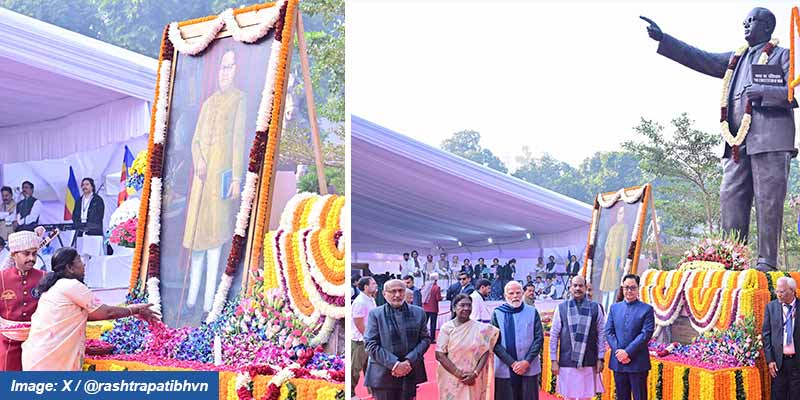
• President Droupadi Murmu, Vice President C.P. Radhakrishnan, Prime Minister Narendra Modi and several other leaders offered tributes to B.R. Ambedkar on his 69th death anniversary in the Parliament House complex on December 6.
• India observes December 6 as Mahaparinirvan Diwas to commemorate the death anniversary of Ambedkar.
An eminent Indian jurist and social reformer
• Dr. Bhim Rao Ambedkar, affectionately called ‘Babasaheb’, was an eminent Indian jurist, economist, and social reformer.
• The architect of India’s Constitution, the champion of the downtrodden and a rebel against all forms of social and economic iniquities, Ambedkar was described by Mahatma Gandhi as a “patriot of sterling worth”.
• He was born on April 14, 1891 at Mhow in Madhya Pradesh.
• He completed his primary schooling in Satara, Maharashtra and completed his secondary education from Elphinstone High School in Bombay.
• His education was achieved in the face of significant discrimination, for he belonged to the Scheduled Caste (then considered as ‘untouchables’).
• In his autobiographical note ‘Waiting for a Visa’, he recalled how he was not allowed to drink water from the common water tap at his school.
• He graduated from Bombay University in 1912 with a BA in economics and political science.
• On account of his excellent performance at college, in 1913 he was awarded a scholarship by Sayajirao Gaikwad, then Maharaja of Baroda state to pursue his MA and PhD at Columbia University in New York.
• After Columbia, Ambedkar moved to London, where he registered at the London School of Economics and Political Science (LSE) to study economics, and enrolled in Grey’s Inn to study law.
• However, due to lack of funds, he had to return to India in 1917. In 1918, he became a professor of political economy at Sydenham College, Bombay.
• After his return to India, Ambedkar founded Bahishkrit Hitkarini Sabha (Society for Welfare of the Ostracised) and led social movements such as Mahad Satyagraha in 1927 to demand justice and equal access to public resources for the historically oppressed castes of the Indian society.
• The Bahiskrit Bharat, newspaper was started in April 3, 1927 to address the cause of the depressed classes
• In the same year, he entered the Bombay Legislative Council as a nominated member.
• Subsequently, he made his submissions before the Indian Statutory Commission also known as the ‘Simon Commission’ on constitutional reforms in 1928.
• The reports of the Simon Commission resulted in the three roundtable conferences between 1930-32, where Ambedkar was invited to make his submissions.
• He played a significant role in the formation of the Reserve Bank of India. The Central bank was formed on the concept presented by Ambedkar to the Hilton Young Commission.
• In 1935, he was appointed as the principal of Government Law College, Mumbai, where he was teaching as a professor since 1928. Thereafter, he was appointed as the Labour Member (1942-46) in the Viceroy’s Executive Council.
• In 1946, he was elected to the Constituent Assembly of India.
• On August 15, 1947, he took oath as the first Law Minister of independent India.
• In 1951, he resigned his ministership, expressing his differences on the Kashmir issue, India’s Foreign Policy and Nehru’s Policy towards the Hindu Code Bill.
• After the first General Election in 1952, he became a member of the Rajya Sabha.
• He was also awarded an honorary doctorate degree from Columbia University in the same year.
• In 1953, he was also awarded another honorary doctorate from Osmania University, Hyderabad.
• Ambedkar was conferred with the title of “Bodhisattva” by the Buddhist monks at “Jagatik Buddhism Council” in 1954 in Kathmandu, Nepal.
• On October 14, 1956, he embraced Buddhism in a historic ceremony in Nagpur and passed away on December 6, 1956.
• In recognition of the distinguished services rendered by Ambedkar, the government of India conferred on him the nation’s highest award, the Bharat Ratna, posthumously, in 1990.