
- India
- May 10
Reinventing Gandhi at Venice Biennale
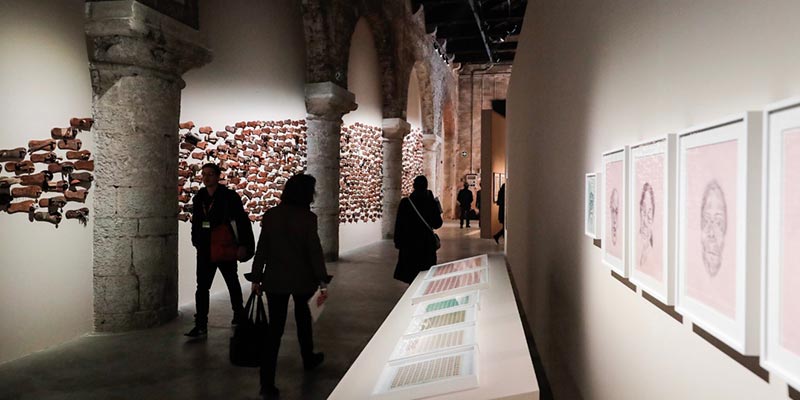
A prosthetic leg in a glass cabinet, a cane armour and a broken terracotta utensil, thousands of ‘padukas’, a series of stamps, a letter and a curtain of mist. In isolation, these objects may or may not hold relevance, but when art curator Roobina Karode placed them one beside the other, not necessarily in the said order, in an old Venetian building, they seem to narrate a tale the story of Mahatma Gandhi in a way never told before.
As the India Pavilion, celebrating 150 years of Gandhi under the overarching theme of ‘Our Times for a Future Caring’ at the Venice Biennale, opened for preview on May 8, the country welcomed a global audience into the idea that is Gandhi.
But this is a Gandhi far removed from the images - spectacles, charka (spinning wheel) and staff - that ‘the father of the nation’ is traditionally associated with.
“The exhibition eludes a literal translation of Gandhi. Rather, the subtle evocation of the man in terms of the conceptual abstraction of his propositions and persistent provocations to rethink our complex world, with his high expectations of art as truth and transformative experience, makes for a compelling visual statement in this day and age,” Karode said.
India has returned to the Biennale with a pavilion of its own after eight years.
In ‘Broken Branches’ by Atul Dodiya, one sees nine wooden cabinets containing hand-coloured framed photographs, used artificial limbs, tools, found objects, billboard paintings and more.
Diagonally, at the other end of the room, sits Ashim Purkayastha’s works. In one them, the artist has created a rugged structure of collected stones used by migrants and homeless people to build shelters in the capital city.
Karode said Dodiya and Purkayastha, both meticulous readers of Gandhi, approach his persona and work as conceptual artists, creating “intimate affinities as well as conflict, between fragment and the whole”.
The show also has on display works by M.F. Husain, Shakuntala Kulkarni, Nandalal Bose, Jitish Kallat, Rumana Hussain and G.R. Iranna.
Curated by the Kiran Nadar Museum of Art, the pavilion has been spearheaded by the culture ministry, co-organised by the Confederation of Indian Industry (CII) and commissioned by the National Gallery of Modern Art (NGMA).
“The presentation is a call for understanding Gandhiji’s ideas for a solution to modern day complexities. The pavilion exhibition weaves together contemporary artworks by eminent artists, emphasising historical moments concerning Gandhiji, or invoking critical thinking in imaginary staged encounters,” said Arun Goel, secretary, culture ministry.