
- India
- Oct 23
Health ministry to launch IMI 2.0
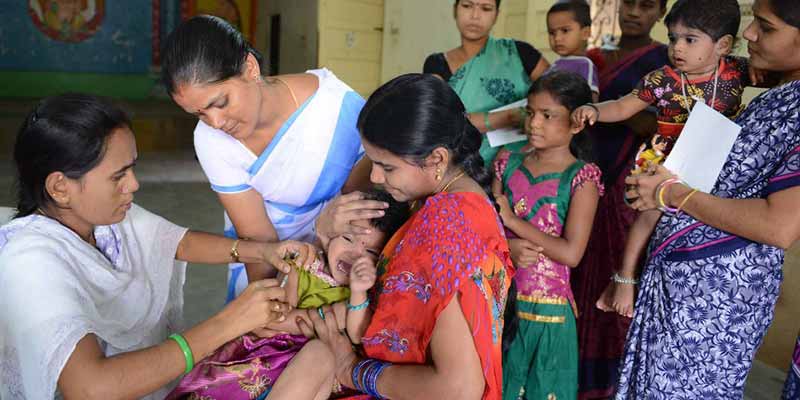
To ensure that not a single child misses out on vaccination, the government will launch the Intensified Mission Indradhanush 2.0 on October 31 with a special focus on improving coverage in areas with low immunisation.
Through IMI 2.0, to be launched as part of the silver jubilee celebrations of the Pulse Polio Programme, the health ministry aims to reach each and every child below the age of two years and all pregnant women still uncovered / partially covered in 271 districts of the country and 652 blocks of Uttar Pradesh and Bihar.
Further, 16 district collectors who have been able to achieve 90 per cent immunisation coverage in their respective districts during the previous rounds of the mission (2017-18), will be felicitated, said Health Minister Harsh Vardhan.
The current national full immunisation coverage rate stands at 87 per cent.
Silver jubilee of Pulse Polio Programme
The success of administering polio vaccination drops to nearly 12 lakh children through 4,000 polio kendras on October 2, 1994 in Delhi led to a countrywide movement and Pulse Polio Programme was taken countrywide in 1995.
“It all began with a single thought that if ballot papers can reach each person, two life-saving drops of vaccination too can reach every child,” Vardhan said as he thanked all stakeholders who contributed to the campaign which led to the eradication of polio from India.
The minister said the best practices and the systems established by the Pulse Polio Programme have benefited other health programmes like community mobilisation, logistics management, reaching the last mile or setting up a surveillance system.
India’s attainment of polio-free status in 2014 was celebrated by the World Health Organisation as “one of the most significant achievements in public health”, and marked not just India but the entire South East Asia region being declared polio-free.
The learnings from the Pulse Polio Programme have helped implementation of other immunisation programmes like the Mission Indradhanush (MI) and the Intensified Mission Indradhanush (IMI).
Mission Indradhanush
The immunisation programme in India was introduced in 1978 as Expanded Programme of Immunisation (EPI) by the ministry of health and family welfare. In 1985, the programme was modified as Universal Immunisation Programme (UIP) to be implemented in a phased manner to cover all districts in the country by 1989-90 with one of the largest health programmes in the world. Despite being operational for many years, UIP has been able to fully immunise only 65 per cent children in the first year of their life.
To strengthen and re-energise the programme and achieve full immunisation coverage for all children and pregnant women at a rapid pace, the government launched Mission Indradhanush in December 2014.
The government has identified 201 high-focus districts across 28 states in the country that have the highest number of partially immunised and unimmunised children.
Intensified Mission Indradhanush
To further intensify the programme, Prime Minister Narendra Modi launched the Intensified Mission Indradhanush (IMI) on October 8, 2017. Through this programme, the government aimed to reach each and every child up to two years of age and all those pregnant women who have been left uncovered under the routine immunisation programme / UIP. The special drive focused on improving immunisation coverage in select districts and cities to ensure full immunisation to more than 90 per cent by December 2018.
The achievement of full immunisation under Mission Indradhanush to at least 90 per cent coverage was to be achieved by 2020 earlier. With the launch of IMI, the achievement of the target was advanced.
Intensified Mission Indradhanush covers low-performing areas in the selected districts (high-priority districts) and urban areas. Special attention is given to unserved / low coverage pockets in sub-centre and urban slums with migratory population. The focus is also on the urban settlements and cities identified under the National Urban Health Mission (NUHM).
Through UIP, the government is providing vaccination free of cost against vaccine preventable diseases such as diphtheria, pertussis, tetanus, polio, measles, severe form of childhood tuberculosis, hepatitis B, meningitis and pneumonia (Haemophilus influenzae type B infections), Japanese encephalitis (JE) in JE endemic districts with introduction of newer vaccines such as rotavirus vaccine, IPV, adult JE vaccine, pneumococcal conjugate vaccine (PCV) and measles-rubella (MR) vaccine in UIP / national immunisation programme.