
- India
- Nov 25
NSO highlights improved water access
As many as 94.5 per cent of families in rural areas and 97.5 per cent in cities used “improved drinking water” from sources such as tubewells, tankers and piped supply during July-December 2018, showed a National Statistical Office (NSO) survey report.
The NSO, a wing of the ministry of statistics and programme implementation, has conducted a survey on drinking water, sanitation, hygiene and housing condition as a part of 76th round (July-December 2018) of National Sample Survey (NSS).
The survey also showed that about 71.3 per cent of families in villages and about 96.2 per cent in cities had access to a latrine.
However, it added that there may be respondent bias in the reporting of access to latrine as question on benefits received by families from government schemes was asked prior to the question on access of households to latrine.
The important aspects on which the information was collected in the survey are: type of the dwelling unit (independent house, flat, etc), tenurial status of the dwelling unit (owned, hired, no dwelling, etc), structure of the dwelling unit (pucca, semi-pucca, katcha), condition of the structure (good, satisfactory, bad), floor area of the dwelling unit, age of the house owned by the household, facilities available to the households in respect of drinking water, bathroom, latrine etc and micro environment surrounding the house like drainage system of the house, system of disposal of household waste water, system of disposal of household garbage, problems of flies and mosquitoes etc.
The survey was spread across the country and for the central sample, data was collected from 1,06,838 households (63,736 in rural areas and 43,102 in urban areas) from 5,378 sample villages in rural areas and 3,614 sample UFS blocks in urban areas, following a scientific survey methodology.
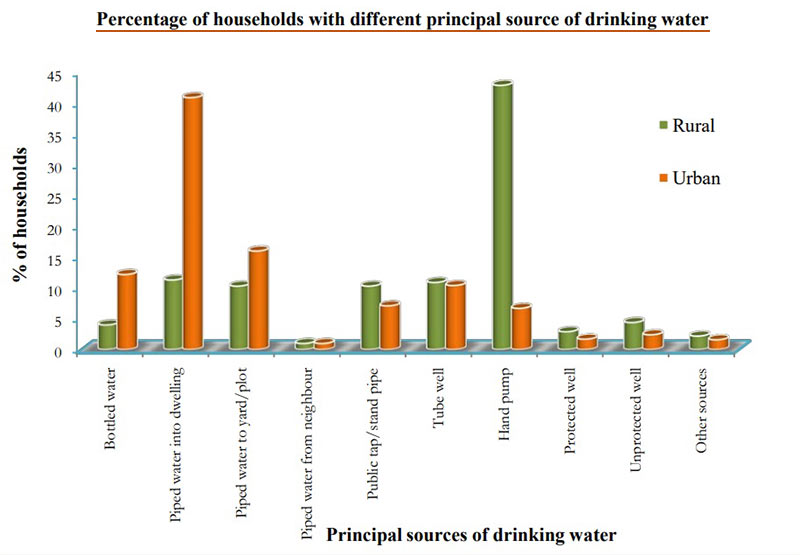
42.9 per cent rural families use hand pump
According to the study, about 94.5 per cent families in villages and about 97.4 per cent in cities used improved source of drinking water, which include bottled water, piped water into dwelling, piped water to yard/plot, piped water from neighbour, public tap / standpipe, tubewell, hand pump, protected well, public tanker truck, private tanker truck, protected spring and rainwater collection.
It showed that the major source of drinking water was hand pumps for the households in the rural areas and piped water into dwelling in the urban areas.
About 42.9 per cent of families in rural areas used hand pump as principal source of drinking water and about 40.9 per cent in cities used piped water into dwelling as the principal source of drinking water.
About 48.6 per cent of families in villages and about 57.5 per cent in cities had exclusive access to principal source of drinking water.
It also said that about 87.6 per cent of families in villages and about 90.9 per cent in cities had sufficient drinking water throughout the year from the principal source.
About 58.2 per cent of families in villages and about 80.7 per cent in cities had drinking water facilities within the household premises.
About 51.4 per cent of families in rural areas and about 72 per cent in urban areas used improved source of drinking water, sufficiently available throughout the year located in the premises.
56.6 per cent rural families use bathrooms
In terms of bathroom and sanitation facility, the report showed that about 50.3 per cent of families in villages and about 75 per cent in cities had exclusive access to a bathroom.
About 56.6 per cent of families in villages and about 91.2 per cent in cities had access to a bathroom.
Among the households that had access to a bathroom, about 48.4 per cent of families in villages and about 74.8 per cent in urban areas used bathroom attached to the dwelling unit.
The major type of latrine used by the households was flush / pour-flush to septic tank in both rural and urban areas.
Among the households that had access to latrine, about 94.7 per cent of the males and 95.7 per cent of the females in villages used latrine regularly while about 98 per cent of the males and 98.1 per cent of the females in cities used latrine regularly.
About 3.5 per cent of family members in villages and about 1.7 per cent in cities never used latrine. About 4.5 per cent in villages and 2.1 per cent in cities reported that water was not available in or around the latrine used.
About 48 per cent of families in villages and about 86.1 per cent in cities had a bathroom and a latrine both within household premises.
Other points of the survey
* On the tenurial status and household characteristics, about 96 per cent of families in villages and 63.8 per cent in cities had their own dwelling unit.
* Among families living in houses, about 76.7 per cent in villages and about 96 per cent in cities had pucca structure. Average floor area of dwelling unit was about 46.6 sq m in villages and about 46.1 sq m in cities.
* Among families living in houses, about 93.9 per cent in villages and 99.1 per cent in cities had electricity for domestic use.
* About 48.3 per cent in villages and about 86.6 per cent in cities used LPG as cooking fuel.
* Similarly, 61.1 per cent of families in villages and about 92 per cent in cities had drainage system in the house.
* About 48.1 per cent of families in villages disposed off household waste water without treatment to open low land areas / streets. In cities, about 71.1 per cent of families disposed off household waste water without treatment to drainage system.
* Similarly, 80.4 per cent of families in villages had no arrangement for collection of household garbage. In cities, panchayat / municipality / corporation made arrangement for collection of household garbage for about 74.1 per cent of families.
Manorama Yearbook app is now available on Google Play Store and iOS App Store