
- India
- Jan 27
Govt signs accord to resolve Bodo issue
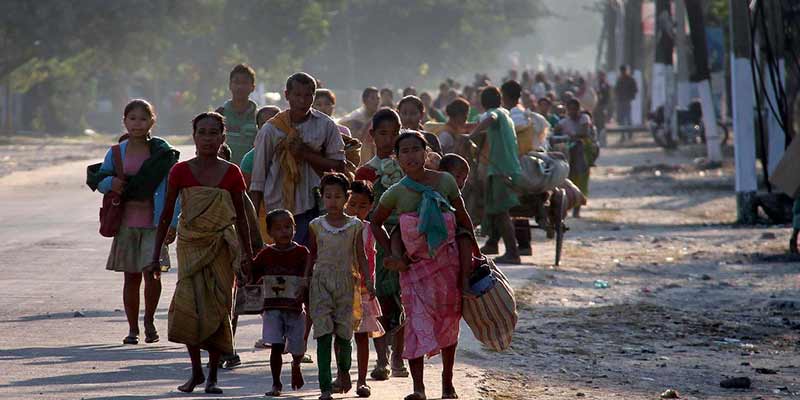
The central government on January 27 signed an accord with the National Democratic Front of Boroland (NDFB) - one of the dreaded insurgent groups of Assam - providing political and economic bonanza without a separate state or Union territory.
The All Bodo Students’ Union (ABSU), which has been spearheading a movement for a Bodoland state since 1972, and another group called the United Bodo People’s Organisation were also signatories to the accord.
In the presence of Home Minister Amit Shah, the tripartite agreement was signed by Assam Chief Minister Sarbananda Sonowal, top leadership of the four factions of the NDFB, ABSU, home ministry joint secretary Satyendra Garg and Assam chief secretary Kumar Sanjay Krishna.
The home minister described the agreement as “historic”, which will “bring a permanent solution to the decades-old problems of the Bodo people”.
“This agreement will facilitate all-round development of the Bodo areas, their language and culture will be protected without compromising the territorial integrity of Assam,” he said.
Due to the violence perpetrated by the Bodo militants, more than 4,000 people lost their lives in the past few decades, he said, adding that no stone would be left unturned for the development of Assam and the Northeastern region.
Sonowal said that different communities in the state will now be able to live in harmony.
Assam minister Himanta Biswa Sarma said as per the accord, 1,550 militants belonging to the NDFB will lay down their arms on January 30, and an economic programme of Rs 1,500 crore will be implemented in the next three years with equal contribution of Rs 750 crore each from the central and state governments.
The existing structure of the Bodoland Territorial Council (BTC) will be strengthened with more powers and its seats will be expanded from 40 to 60, he said.
A commission will be set up for inclusion of Bodo-dominated villages in the BTC and the exclusion of those where Bodos are not in a majority.
This is the third Bodo accord to be signed in the past 27 years when the violent movement for a separate Bodoland state claimed hundreds of lives, destruction of public and private properties.
The first Bodo accord was signed with the All Bodo Students Union in 1993, leading to the creation of a Bodoland Autonomous Council with limited political powers.
In 2003, the second Bodo accord was signed with the militant group Bodo Liberation Tigers, leading to the formation of the BTC with four districts of Assam - Kokrajhar, Chirang, Baska and Udalguri - called Bodoland Territorial Area District (BTAD).
The name of the BTC will be changed to Bodoland Territorial Region (BTR).
The BTC currently has control over 30 subjects such as education, forests, horticulture but no jurisdiction over the police, revenue and general administration departments, which are controlled by the Assam government.
The BTC was formed under the 6th Schedule of the Constitution.
The demand for a separate state for the Bodos has been going on in Assam for about five decades and several Bodo overground and militant groups raising it leading to agitations, protests, violence and many deaths.
Manorama Yearbook app is now available on Google Play Store and iOS App Store