
- India
- Apr 22
Daily Briefing / April 22, 2020
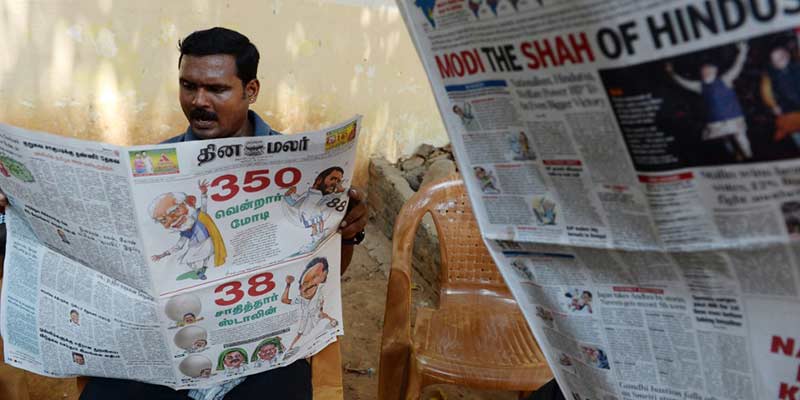
India slips to 142 on global press freedom index
The coronavirus pandemic is exacerbating threats to press freedom around the world, with authoritarian states including China and Iran suppressing details of the outbreak, activists said. Paris-based Reporters Sans Frontieres (RSF), or Reporters Without Borders, said in its annual press freedom rankings that the pandemic was “highlighting and amplifying the many crises” already casting a shadow on press freedom. India has dropped two places to be ranked 142nd out of 180 countries in the ‘World Press Freedom Index 2020’. South Asia in general features poorly on the index, with Pakistan dropping three places to 145, and Bangladesh dropping one place to 151. Norway is ranked first in the index for the fourth year running, while Finland was again the runner-up. North Korea took last position (180) from Turkmenistan, and Eritrea continued to be Africa’s lowest-ranked country at number 178. Published annually by RSF since 2002, the World Press Freedom Index assesses factors such as media independence, self-censorship, the legal framework and transparency based on a questionnaire filled out by experts.
Trump suspends issuing of new green cards for 60 days
President Donald Trump has said that he will suspend immigration to the US and place a pause on the issuance of new green cards for the next 60 days as part of his efforts to protect American workers, amidst the coronavirus crisis that has wreaked havoc in the country. Trump, seeking re-election in November, said his executive order to ban immigration will last for 60 days and apply only to those seeking permanent residence in the country. Under the existing law, the US can issue a maximum of 1,40,000 employment-based green cards every year with a per country cap of 7 per cent. Accordingly, in fiscal year 2019, Indian nationals received 9,008 category 1 (EB1), 2,908 category 2 (EB2), and 5,083 category 3 (EB3) green cards. EB1-3 are different categories of employment-based green cards.
Trump threatens to terminate trade deal with China
US President Donald Trump has threatened to terminate the trade deal with China if Beijing did not honour its provisions in the wake of the coronavirus pandemic that originated in the country. While China has reported 82,788 novel coronavirus cases, including 4,632 fatalities, the US registered over 824,600 cases and more than 45,290 deaths — the highest in the world. China and the US in January signed phase-1 of the trade deal as the world’s two top economic powers moved forward to end their bitter tit-for-tat two-year tariff war that had rattled markets and weighed on the global economy. The deal, which calls on China to buy $200 billion worth of US products, is set to move ahead as planned. However, the US-China Economic and Security Review Commission in a report said China could invoke a clause in the agreement that allows for fresh trade consultations between the two countries “in the event of a natural disaster or other unforeseeable event”. “If that happens, we’ll do a termination and we’ll do what I can do better than anybody,” Trump told reporters.
Iran launches its first military satellite
Iran’s Revolutionary Guard said on April 22 that it put the country’s first military satellite into orbit, dramatically unveiling what experts described as a secret space programme with a surprise launch that came amid wider tensions with the US. There was no immediate independent confirmation of the launch of the satellite, which the Guard called ‘Noor’. However, such a launch immediately raised concerns among experts on whether the technology used could help Iran develop intercontinental ballistic missiles. On its official website, the Guard said the satellite successfully reached an orbit of 425 kilometers above the Earth’s surface. The three-stage satellite launch took off from Iran’s Central Desert.
US state files lawsuit against China
Missouri has become the first US State to sue China, alleging that Beijing suppressed formation, arrested whistleblowers and denied the contagious nature of the novel coronavirus that led to the loss of life and caused “irreparable damage” to countries globally. The civil lawsuit, filed in federal court against the Chinese government by Missouri Attorney General Eric Schmitt, alleges negligence, among other claims. The lawsuit alleges that during the critical weeks of the initial outbreak, the Chinese authorities deceived the public, suppressed crucial information, arrested whistleblowers, denied human-to-human transmission in the face of mounting evidence, destroyed critical medical research, permitted millions of people to be exposed to the virus, and even hoarded personal protective equipment (PPE), causing a global pandemic that was unnecessary and preventable.
Manorama Yearbook app is now available on Google Play Store and iOS App Store