
- India
- Jul 10
Explainer / Mongolian Kanjur
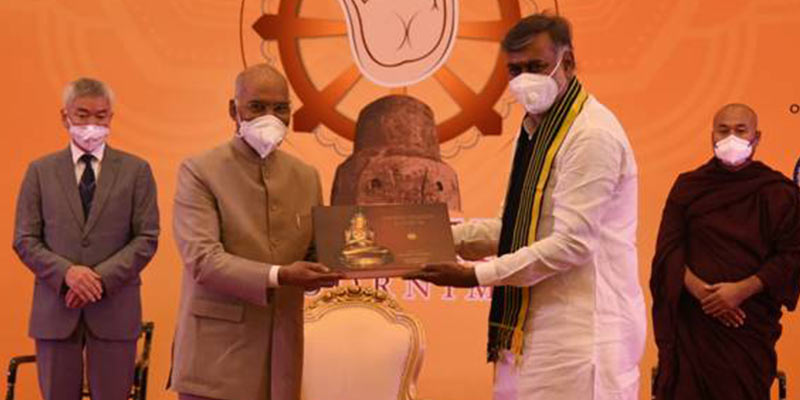
First set of five volumes of Mongolian Kanjur published by the National Mission for Manuscripts (NMM) was presented to President Ram Nath Kovind on the occasion of Guru Purnima, also known as Dharma Chakra Day, on July 4.
Minister of Culture Prahlad Patel also handed over a set to the ambassador of Mongolia to India.
The ministry is planning to publish all the 108 volumes of the Mongolian Kanjur by March 2022.
Mongolian Kanjur
Mongolian Kanjur, the Buddhist canonical text in 108 volumes is considered to be the most important religious text in Mongolia. In the Mongolian language ‘Kanjur’ means ‘Concise Orders’ - the words of Lord Buddha in particular.
The Kanjur are kept in almost every monastery in Mongolia. It is held in high esteem by the Mongolian Buddhists and they worship the Kanjur at temples and recite the lines of Kanjur in daily life as a sacred ritual.
Mongolian Kanjur has been translated from Tibetan. The language of the Kanjur is Classical Mongolian.The Mongolian Kanjur is a source of providing a cultural identity to Mongolia.
During the socialist period, xylographs were consigned to flames and monasteries were bereft of their sacred scriptures. During 1956-58, Professor Raghu Vira obtained a microfilm copy of the rare Kanjur manuscripts and brought them to India. The Mongolian Kanjur in 108 volumes was published in India in the 1970s.
Now, the present edition is being published by the National Mission for Manuscripts in which every volume will have a list of contents indicating the original title of the sutra in Mongolian. This work is being carried out under the supervision of eminent scholar Lokesh Chandra.
What is a manuscript?
A manuscript is a handwritten composition on paper, bark, cloth, metal, palm leaf or any other material that has significant scientific, historical or aesthetic value.
Lithographs and printed volumes are not manuscripts. Manuscripts are found in hundreds of different languages and scripts.
Manuscripts are distinct from historical records such as epigraphs on rocks, firmans, revenue records which provide direct information on events or processes in history.
National Mission for Manuscripts
The National Mission for Manuscripts was launched in February 2003 under the ministry of tourism and culture, with the mandate of documenting, conserving and disseminating the knowledge preserved in the manuscripts.
A unique project in its programme and mandate, the mission seeks to unearth and preserve the vast manuscript wealth of India. India possesses an estimate of ten million manuscripts, probably the largest collection in the world. These cover a variety of themes, textures and aesthetics, scripts, languages, calligraphies, illuminations and illustrations.
One of the objectives of the mission is to publish rare and unpublished manuscripts so that the knowledge enshrined in them is spread to researchers, scholars and the general public.
NMM is working towards fulfilling its motto, ‘conserving the past for the future’.
Objectives of NMM
* Locate manuscripts through national level survey and post-survey.
* Document each and every manuscript for a National Electronic Database that currently contains information on four million manuscripts making this the largest database on Indian manuscripts in the world.
* Conserve manuscripts incorporating both modern and indigenous methods of conservation and training a new generation of manuscript conservators.
* To train the next generation of scholars in various aspects of manuscript studies like languages, scripts and critical editing and cataloguing of texts and conservation of manuscripts.
* To promote access to manuscripts by digitising the rarest and most endangered manuscripts.
* To promote access to manuscripts through publication of critical editions of unpublished manuscripts and catalogues.
India-Mongolia relations
Historical interaction between India and Mongolia goes back centuries. Buddhism was spread in Mongolia by Indian cultural and religious ambassadors. Today, Buddhists form the single largest religious denomination in Mongolia.
India established formal diplomatic relations with Mongolia in 1955. Since then, the bilateral ties between both countries have reached new heights.
Now, the publication of Mongolian Kanjur by the government of India will act as a symbol of cultural symphony between both countries and will contribute to furtherance of bilateral relations during the coming years.
Manorama Yearbook app is now available on Google Play Store and iOS App Store