
- India
- Jul 18
India plans to store oil in US reserves
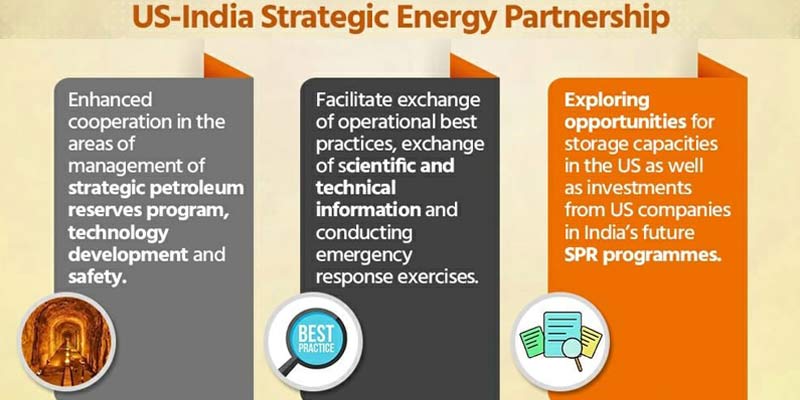
India and the US have signed an MoU to develop a strategic petroleum reserve in America. The two countries are in an advanced stage of discussion to store crude oil in the US to increase India’s stockpile.
Union Minister of Petroleum and Natural Gas Dharmendra Pradhan co-chaired with his American counterpart Energy Secretary Dan Brouillette a virtual US-India Strategic Energy Partnership Ministerial.
What is strategic petroleum reserve?
Indian government has set up 5.33 million tonnes of emergency storage built in underground rock caverns in Mangalore and Padur in Karnataka and Visakhapatnam in Andhra Pradesh. These strategic storages are in addition to the storages of crude oil and petroleum products with the oil companies and serve as a cushion during any supply disruptions.
In the US, the Strategic Petroleum Reserve (SPR), the world’s largest supply of emergency crude oil, was established primarily to reduce the impact of disruptions in supplies of petroleum products and to carry out obligations of the country under the international energy programme.
The federally-owned oil stocks are stored in huge underground salt caverns at four sites along the coastline of the Gulf of Mexico. The sheer size of the SPR (authorised storage capacity of 714 million barrels) makes it a significant deterrent to oil import cutoffs and a key tool in foreign policy.
US-India Strategic Energy Partnership
PM Modi and US President Donald Trump announced the establishment of US-India Strategic Energy Partnership during their summit in June 2017 in Washington, D.C.
The inaugural meeting of the US-India SEP was held in April 2018.
The partnership affirms the strategic importance of energy cooperation to India-US bilateral relationship and sets the stage for deeper and more meaningful engagements through government and industry channels.
Through the partnership, Indian and the US collectively seek to enhance energy security, expand energy and innovation linkages across respective energy sectors, bolster strategic alignment and facilitate increased industry and stakeholder engagement.
Both sides pursue four primary pillars of cooperation:
1) Oil and Gas
2) Power and Energy Efficiency
3) Renewable Energy and
4) Sustainable Growth
The SEP elevates the role of energy in advancing shared goals, including universal energy access, strengthened energy security and increased energy efficiency.
The partnership will create important opportunities for advancing favorable policies and commercial investments in support of these goals, including in natural gas markets.
What are the key outcomes of the meeting?
Enhancing Energy Security: The two sides signed a Memorandum of Understanding (MOU) to begin cooperation on Strategic Petroleum Reserves operation and maintenance, including exchange of information and best practices. They also discussed the possibility of India storing oil in the US Strategic Petroleum Reserve to increase their nation’s strategic oil stockpile.
Following the historic drop in global crude oil process, the Indian government actively considered increasing its oil stockpile both inside the country and also overseas in countries like the US, Pradhan said.
The government will come out with a concrete road map and proposal on how it can be unfolded, Pradhan added.
Promoting Energy Trade and Investment: Both countries noted the significant increase in bilateral hydrocarbon trade since the establishment of SEP, with the bilateral hydrocarbon trade touching $9.2 billion during 2019-20, marking a 93 per cent increase since 2017-18, and affirmed to promote greater hydrocarbon trade between the two countries.
Harnessing Innovation: The two sides launched a public-private Hydrogen Task Force to help scale up technologies to produce hydrogen from renewable energy and fossil fuel sources and to bring down the cost of deployment for enhanced energy security and resiliency.
They also signed an MoU to collaborate on first-ever Solar Decathlon India in 2021, establishing a collegiate competition to prepare the next generation of building professionals to design and build high efficiency buildings powered by renewables.
They jointly launched collaboration between the US DOE National labs and the national institutes under the ministry of new & renewable energy as part of the newly launched South Asia Group for Energy (SAGE), supported by USAID, for joint research on development and deployment of advanced clean technologies.
Manorama Yearbook app is now available on Google Play Store and iOS App Store