
- India
- Feb 02
Schemes in Budget 2021 / PM Atmanirbhar Swasth Bharat Yojana
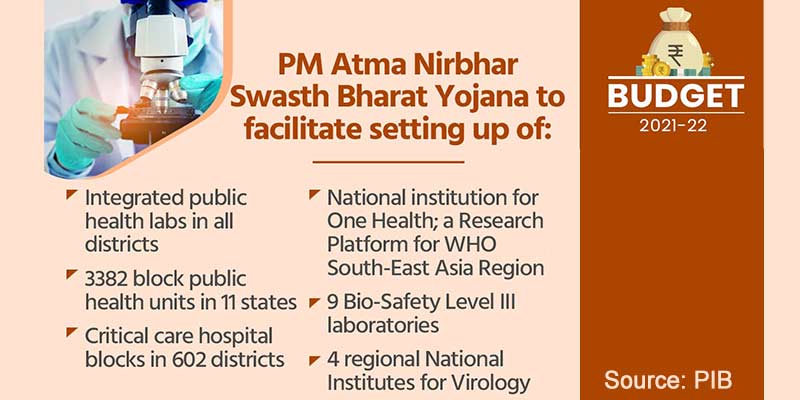
• Finance Minister Nirmala Sitharaman announced that a new centrally sponsored scheme, Prime Minister Atmanirbhar Swasth Bharat Yojana, will be launched with an outlay of about Rs 64,180 crore over six years.
• The centrally sponsored scheme will be in addition to the National Health Mission.
The objectives of the scheme are:
• To develop capacities of primary, secondary, and tertiary care health systems.
• Strengthen existing national institutions.
• Create new institutions to cater to detection and cure of new and emerging diseases.
The main interventions under the scheme are:
1) Support for 17,788 rural and 11,024 urban health and wellness
centers.
2) Setting up integrated public health labs in all districts and 3,382 block
public health units in 11 states.
3) Establishing critical care hospital blocks in 602 districts and 12
central institutions.
4) Strengthening of the National Centre for Disease Control (NCDC), its
five regional branches and 20 metropolitan health surveillance units.
5) Expansion of the Integrated Health Information Portal to all
states/UTs to connect all public health labs.
6) Operationalisation of 17 new Public Health Units and strengthening
of 33 existing Public Health Units at points of entry, that is at 32
airports, 11 seaports and 7 land crossings.
7) Setting up of 15 health emergency operation centers and two mobile
hospitals.
8) Setting up of a national institution for One Health, a regional research platform for WHO South East Asia Region, nine Bio-Safety Level III laboratories and four regional National Institutes for Virology.
National Centre for Disease Control (NCDC)
• The National Centre for Disease Control (NCDC), formerly National Institute of Communicable Diseases (NICD), had its origin as Central Malaria Bureau. It was established in Kasauli (Himachal Pradesh) in 1909. Following expansion, it was renamed in 1927 as the Malaria Survey of India.
• It was shifted to Delhi in 1938 and called the Malaria Institute of India (MII).
• In view of the drastic reduction achieved in the incidence of malaria under the National Malaria Eradication Programme (NMEP), the government decided to reorganise and expand the activities of the institute to cover other communicable diseases.
• In 1963 the erstwhile MII was renamed as National Institute of Communicable Diseases (NICD) to shoulder these additional responsibilities.
• In 2009, NICD was renamed as the National Centre for Disease Control (NCDC) with a larger mandate of controlling emerging and re-emerging diseases.
Manorama Yearbook app is now available on Google Play Store and iOS App Store