
- India
- Feb 01
- Mathew Gregory
Highlights of Union Budget 2021-22
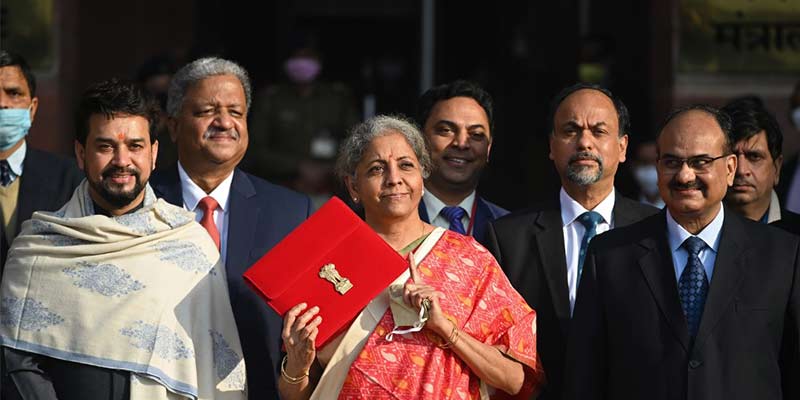
6 pillars of the Union Budget 2021-22
• Health and Wellbeing
• Physical & Financial Capital, and Infrastructure
• Inclusive Development for Aspirational India
• Reinvigorating Human Capital
• Innovation and R&D
• Minimum Government and Maximum Governance
1) Health and Wellbeing
◦ Rs. 2,23,846 crore outlay for Health and Wellbeing in BE 2021-22 as against Rs. 94,452 crore in BE 2020-21 – an increase of 137%
◦ Focus on strengthening three areas: Preventive, Curative, and Wellbeing.
a. Vaccines
• Rs. 35,000 crore for COVID-19 vaccine in BE 2021-22
• The Made-in-India Pneumococcal Vaccine to be rolled out across the country, from present 5 states – to avert 50,000 child deaths annually.
b. Health Systems
• Rs. 64,180 crore outlay over 6 years for PM AatmaNirbhar Swasth Bharat Yojana – a new centrally sponsored scheme to be launched, in addition to NHM.
• Under PM AatmaNirbhar Swasth Bharat Yojana
◦ National Institution for One Health: 17,788 rural and 11,024 urban Health and Wellness Centers
◦ 4 regional National Institutes for Virology
◦ 15 Health Emergency Operation Centers and 2 mobile hospitals
◦ Integrated public health labs in all districts and 3382 block public health units in 11 states
◦ Critical care hospital blocks in 602 districts and 12 central institutions
◦ Strengthening of the National Centre for Disease Control (NCDC), its 5 regional branches and 20 metropolitan health surveillance units.
◦ Expansion of the Integrated Health Information Portal to all States/UTs to connect all public health labs
◦ 17 new Public Health Units and strengthening of 33 existing Public Health Units
◦ Regional Research Platform for WHO South-East Asia Region
◦ 9 Bio-Safety Level III laboratories
c. Nutrition
• Mission Poshan 2.0 to be launched
◦ To strengthen nutritional content, delivery, outreach, and outcome
◦ Merging the Supplementary Nutrition Programme and the Poshan Abhiyan
◦ Intensified strategy to be adopted to improve nutritional outcomes across 112 Aspirational Districts
d. Universal Coverage of Water Supply
• Rs. 2,87,000 crore over 5 years for Jal Jeevan Mission (Urban) - to be launched with an aim to provide:
◦ 2.86 crore household tap connections
◦ Universal water supply in all 4,378 Urban Local Bodies
◦ Liquid waste management in 500 AMRUT cities
e. Swachch Bharat, Swasth Bharat
• Rs. 1,41,678 crore over 5 years for Urban Swachh Bharat Mission 2.0
• Main interventions under Swachh Bharat Mission (Urban) 2.0:
◦ Complete faecal sludge management and waste water treatment
◦ Source segregation of garbage
◦ Reduction in single-use plastic
◦ Reduction in air pollution by effectively managing waste from construction-and-demolition activities
◦ Bio-remediation of all legacy dump sites
f. Clean Air
• Rs. 2,217 crore to tackle air pollution, for 42 urban centers with a million-plus population
g. Scrapping Policy
• Voluntary vehicle scrapping policy to phase out old and unfit vehicles
• Fitness tests in automated fitness centres:
◦ After 20 years in case of personal vehicles
◦ After 15 years in case of commercial vehicles
2) Physical and Financial Capital and Infrastructure
a. Production Linked Incentive scheme (PLI)
• Rs. 1.97 lakh crore in next 5 years for PLI schemes in 13 Sectors
• To create and nurture manufacturing global champions for an AatmaNirbhar Bharat
• To help manufacturing companies become an integral part of global supply chains, possess core competence and cutting-edge technology
• To bring scale and size in key sectors
• To provide jobs to the youth
b. Textiles
• Mega Investment Textiles Parks (MITRA) scheme, in addition to PLI: 7 Textile Parks to be established over 3 years
• Textile industry to become globally competitive, attract large investments and boost employment generation & exports
c. Infrastructure
• National Infrastructure Pipeline (NIP) expanded to 7,400 projects: Around 217 projects worth Rs. 1.10 lakh crore completed.
• Measures in three thrust areas to increase funding for NIP:
• Creation of institutional structures
▪ Rs. 20,000 crore to set up and capitalise a Development Financial Institution(DFI) – to act as a provider, enabler and catalyst for infrastructure financing
▪ Rs. 5 lakh crore lending portfolio to be created under the proposed DFI in 3 years
▪ Debt Financing by Foreign Portfolio Investors to be enabled by amending InvITs’ and REITs’ legislations.
• Big thrust on monetizing assets
◦ National Monetization Pipeline to be launched
◦ Important asset monetization measures:
▪ 5 operational toll roads worth Rs. 5,000 crore being transferred to the NHAIInvIT
▪ Transmission assets worth Rs. 7,000 crore to be transferred to the PGCILInvIT
▪ Dedicated Freight Corridor assets to be monetized by Railways, for operations and maintenance, after commissioning
▪ Next lot of Airports to be monetized for operations and management concession
• Other core infrastructure assets to be rolled out under the Asset Monetization Programme:
▪ Oil and Gas Pipelines of GAIL, IOCL and HPCL
▪ AAI Airports in Tier II and III cities
▪ Other Railway Infrastructure Assets
▪ Warehousing Assets of CPSEs such as Central Warehousing Corporation and NAFED
▪ Sports Stadiums
• Enhancing the share of capital expenditure
▪ Rs. 5.54 lakh crore capital expenditure in BE 2021-22 – sharp increase of 34.5% over Rs. 4.12 lakh crore allocated in BE 2020-21 :
▪ Over Rs. 2 lakh crore to States and Autonomous Bodies for their Capital Expenditure.
▪ Over Rs. 44,000 crore for the Department of Economic Affairs to provide for projects/programmes/departments exhibiting good progress on Capital Expenditure.
d. Roads and Highways Infrastructure
• Rs. 1,18,101 lakh crore, highest ever outlay, for Ministry of Road Transport and Highways – of which Rs. 1,08,230 crore is for capital
• Under the Rs. 5.35 lakh crore Bharatmala Pariyojana, more than 13,000 km length of roads worth Rs. 3.3 lakh crore awarded for construction:
◦ 3,800 km have already been constructed
◦ Another 8,500 km to be awarded for construction by March 2022
◦ Additional 11,000 km of national highway corridors to be completed by March 2022
• Economic corridors being planned:
◦ Rs. 1.03 lakh crore outlay for 3,500 km of NHs in Tamil Nadu
◦ Rs. 65,000 crore investment for 1,100 km of NHs in Kerala
◦ Rs. 25,000 crore for 675 km of NHs in West Bengal
◦ Over Rs. 34,000 crore to be allocated for 1300 km of NHs to be undertaken in next 3 years in Assam, in addition to Rs. 19,000 crore works of NHs currently in progress in the State.
• Flagship Corridors/Expressways:
◦ Delhi-Mumbai Expressway – Remaining 260 km to be awarded before 31.3.2021
◦ Bengaluru-Chennai Expressway – 278 km to be initiated in the current FY; construction to begin in 2021-22
◦ Kanpur-Lucknow Expressway – 63 km expressway providing an alternate route to NH 27 to be initiated in 2021-22
◦ Delhi-Dehradun economic corridor – 210 km to be initiated in the current FY; construction to begin in 2021-22
◦ - Raipur-Vishakhapatnam – 464 km passing through - Chhattisgarh, Odisha and North Andhra Pradesh, to be awarded in the current year; construction to start in 2021-22
◦ Chennai-Salem corridor – 277 km expressway to be awarded and construction to start in 2021-22
◦ Amritsar-Jamnagar – Construction to commence in 2021-22
◦ Delhi-Katra – Construction will commence in 2021-22.
• Advanced Traffic management system in all new 4 and 6-lane highways:
◦ Speed radars
◦ Variable message signboards
◦ GPS enabled recovery vans will be installed
e. Railway Infrastructure
• Rs. 1,10,055 crore for Railways of which Rs. 1,07,100 crore is for capital expenditure
• National Rail Plan for India (2030): to create a ‘future ready’ Railway system by 2030
• 100% electrification of Broad-Gauge routes to be completed by December, 2023
• Broad Gauge Route Kilometers (RKM) electrification to reach 46,000 RKM, i.e. 72% by end of 2021
• Western Dedicated Freight Corridor (DFC) and Eastern DFC to be commissioned by June 2022, to bring down the logistic costs – enabling Make in India strategy
• Additional initiatives proposed:
◦ The Sonnagar-Gomoh Section (263.7 km) of Eastern DFC to be taken up in PPP mode in 2021-22
◦ Future dedicated freight corridor projects –
▪ East Coast corridor from Kharagpur to Vijayawada
▪ East-West Corridor from Bhusaval to Kharagpur to Dankuni
▪ North-South corridor from Itarsi to Vijayawada
• Measures for passenger convenience and safety:
◦ Aesthetically designed Vista Dome LHB coach on tourist routes for better travel
◦ High density network and highly utilized network routes to have an indigenously developed automatic train protection system, eliminating train collision due to human error.
f. Urban Infrastructure
• Raising the share of public transport in urban areas by expansion of metro rail network and augmentation of city bus service
• Rs. 18,000 crore for a new scheme, to augment public bus transport:
◦ Innovative PPP models to run more than 20,000 buses
◦ To boost automobile sector, provide fillip to economic growth, create employment opportunities for our youth
• A total of 702 km of conventional metro is operational and another 1,016 km of metro and RRTS is under construction in 27 cities
• ‘MetroLite’ and ‘MetroNeo’ technologies to provide metro rail systems at much lesser cost with similar experience in Tier-2 cities and peripheral areas of Tier-1 cities.
• Central counterpart funding to:
◦ Kochi Metro Railway Phase-II of 11.5 km at a cost of Rs. 1957.05 crore
◦ Chennai Metro Railway Phase –II of 118.9 km at a cost of Rs. 63,246 crore
◦ Bengaluru Metro Railway Project Phase 2A and 2B of 58.19 km at a cost of Rs. 14,788 crore
◦ Nagpur Metro Rail Project Phase-II and Nashik Metro at a cost of Rs. 5,976 crore and Rs. 2,092 crore respectively.
g. Power Infrastructure
• 139 Giga Watts of installed capacity and 1.41 lakh circuit km of transmission lines added, and additional 2.8 crore households connected in past 6 years
• Consumers to have alternatives to choose the Distribution Company for enhancing competitiveness
• Rs. 3,05,984 crore over 5 years for a revamped, reforms-based and result-linked new power distribution sector scheme
• A comprehensive National Hydrogen Energy Mission 2021-22 to be launched.
h. Ports, Shipping, Waterways
• Rs. 2,000 crore worth 7 projects to be offered in PPP-mode in FY21-22 for operation of major ports
• Indian shipping companies to get Rs. 1624 crore worth subsidy support over 5 years in global tenders of Ministries and CPSEs
• To double the recycling capacity of around 4.5 Million Light Displacement Tonne (LDT) by 2024; to generate an additional 1.5 lakh jobs.
i. Petroleum & Natural Gas
• Extention of Ujjwala Scheme to cover 1 crore more beneficiaries
• To add 100 more districts to the City Gas Distribution network in next 3 years
• A new gas pipeline project in J&K
• An independent Gas Transport System Operator to be set up for facilitation and coordination of booking of common carrier capacity in all-natural gas pipelines on a non-discriminatory open access basis.
j. Financial Capital
• A single Securities Markets Code to be evolved
• Support for development of a world class Fin-Tech hub at the GIFT-IFSC
• A new permanent institutional framework to help in development of Bond market by purchasing investment grade debt securities both in stressed and normal times
• Setting up a system of Regulated Gold Exchanges: SEBI to be notified as a regulator and Warehousing Development and Regulatory Authority to be strengthened
• To develop an investor charter as a right of all financial investors
• Capital infusion of Rs. 1,000 crore to Solar Energy Corporation of India and Rs. 1,500 crore to Indian Renewable Energy Development Agency.
k. Increasing FDI in Insurance Sector
• To increase the permissible FDI limit from 49% to 74% and allow foreign ownership and control with safeguards
l. Stressed Asset Resolution
• Asset Reconstruction Company Limited and Asset Management Company to be set up
m. Recapitalization of PSBs
• Rs. 20,000 crore in 2021-22 to further consolidate the financial capacity of PSBs
n. Deposit Insurance
• Amendments to the DICGC Act, 1961, to help depositors get an easy and time-bound access to their deposits to the extent of the deposit insurance cover
• Minimum loan size eligible for debt recovery under the Securitisation and Reconstruction of Financial Assets and Enforcement of Security Interest (SARFAESI) Act, 2002 proposed to be reduced from Rs. 50 lakh to Rs. 20 lakh for NBFCs with minimum asset size of Rs. 100 crore.
o. Company Matters
• To decriminalize the Limited Liability Partnership (LLP) Act, 2008
• Easing Compliance requirement of Small companies by revising their definition under Companies Act, 2013 by increasing their thresholds for Paid up capital from “not exceeding Rs. 50 Lakh” to “not exceeding Rs. 2 Crore” and turnover from “not exceeding Rs. 2 Crore” to “not exceeding Rs. 20 Cr”.
• Promoting start-ups and innovators by incentivizing the incorporation of One Person Companies (OPCs):
◦ Allowing their growth without any restrictions on paid up capital and turnover
◦ Allowing their conversion into any other type of company at any time,
◦ Reducing the residency limit for an Indian citizen to set up an OPC from 182 days to 120 days and
◦ Allowing Non Resident Indians (NRIs) to incorporate OPCs in India.
• To ensure faster resolution of cases by:
◦ Strengthening NCLT framework
◦ Implementation of e-Courts system
◦ Introduction of alternate methods of debt resolution and special framework for MSMEs
• Launch of data analytics, artificial intelligence, machine learning driven MCA21 Version 3.0 in 2021-22.
p. Disinvestment and Strategic Sale
• Rs. 1,75,000 crore estimated receipts from disinvestment in BE 2020-21
• Strategic disinvestment of BPCL, Air India, Shipping Corporation of India, Container Corporation of India, IDBI Bank, BEML, Pawan Hans, Neelachal Ispat Nigam limited etc. to be completed in 2021-22.
• Other than IDBI Bank, two Public Sector Banks and one General Insurance company to be privatized
• IPO of LIC in 2021-22
• New policy for Strategic Disinvestment approved; CPSEs except in four strategic areas to be privatized
• NITI Aayog to work out on the next list of CPSEs to be taken up for strategic disinvestment
• Incentivizing States for disinvestment of their Public Sector Companies, using central funds
• Special Purpose Vehicle in the form of a company to monetize idle land
• Introducing a revised mechanism for ensuring timely closure of sick or loss making CPSEs.
(The author is a trainer for Civil Services aspirants. The views expressed here are personal.)