
- India
- May 28
Centre to roll out Unified Health Interface under NDHM
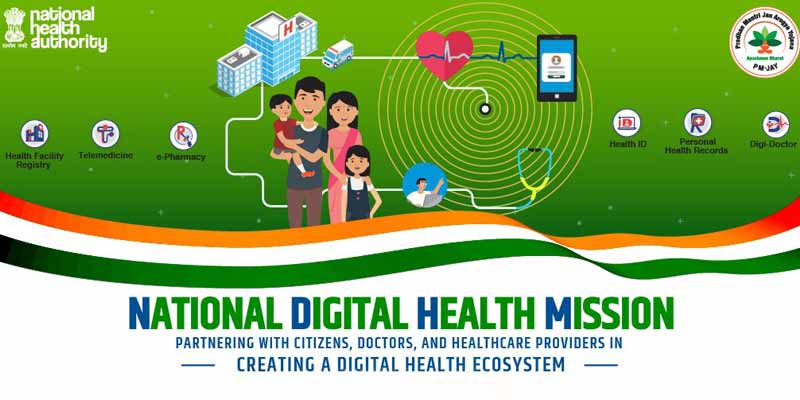
Chairing a high-level meeting to review the National Digital Health Mission (NDHM), Prime Minister Narendra Modi said that it will bring ease of living for citizens as they can avail a large number of health services via it.
What is NDHM?
• Modi had announced the launch of NDHM during his Independence Day address in 2020.
• Since then, the digital modules and registries have been developed and the mission has been rolled out in six Union Territories. So far, nearly 11.9 lakh Health IDs have been generated and 3,106 doctors and 1,490 facilities have registered on the platform.
• The NDHM is a voluntary health care programme that will reduce the existing gap between various stakeholders such as doctors, hospitals and other health care providers, pharmacies, insurance companies, and citizens by bringing them together and connecting them in an integrated digital health infrastructure
• The National Health Authority (NHA), the apex central government agency responsible for the implementation of Ayushman Bharat Pradhan Mantri Jan Arogya Yojana, has been given the mandate by the government to design, build, rollout and implement the mission in the country.
What are the components of NDHM?
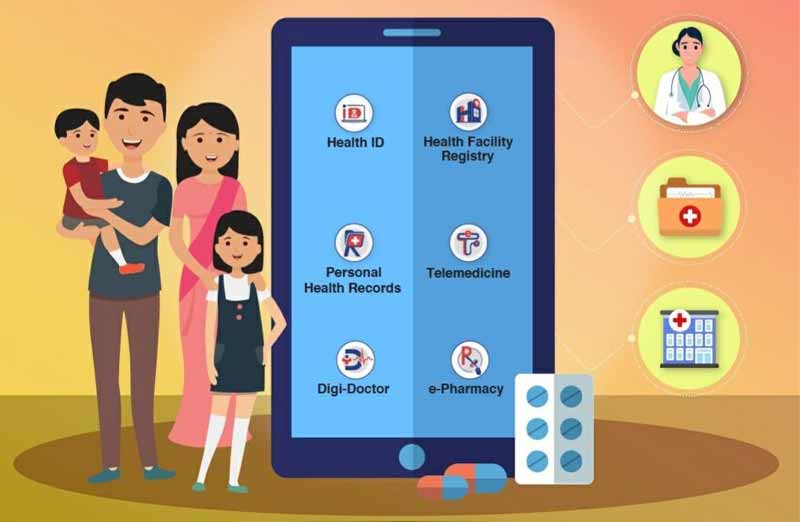
The NDHM comprises several key building blocks or digital systems that will enable access to timely, safe and affordable health care through a ‘citizen-centric’ approach.
1) Health ID: Every patient who wishes to have their health records available digitally must start by creating a Health ID. Each Health ID will be linked to a health data consent manager which will be used to seek the patient’s consent and allow for seamless flow of health information from the Personal Health Records module. Health ID is created by using basic details and Mobile Number or Aadhaar Number. It will be used for the purposes of uniquely identifying persons, authenticating them, and threading their health records (only with the informed consent of the patient) across multiple systems and stakeholders.
2) Digi-Doctor: It is a comprehensive repository of all doctors practicing or teaching modern/ traditional systems of medicine. Enrolling on Digi-Doctor is completely voluntary and enables doctors to get connected to India’s digital health ecosystem.
3) Health Facility Registry: It is a comprehensive repository of health facilities of the country across different systems of medicine. It includes both public and private health facilities including hospitals, clinics, diagnostic laboratories and imaging centers, pharmacies, etc. It is a key building block needed to support the unified digital health ecosystem of the country.
4) Personal Health Records: It is an electronic record of health-related information on an individual that conforms to nationally recognised interoperability standards and that can be drawn from multiple sources while being managed, shared, and controlled by the individual. The most salient feature of the PHR is that the information it contains is under the control of the individual. The functions that are supported by a Personal Health Record-System (PHR) are those that enable an individual to manage information about his or her health care.
5) Electronic Medical Record (EMR): It is a digital version of a patient’s treatment history from a single facility. The health information recorded in a facility is stored locally at the facility where the patient was registered. The web EMR application is an easy to use application with minimal functions but sufficient enough to capture important clinical details about the patient’s care in a facility.
Other two components are e-Pharmacy and telemedicine. All of these systems, except e-Pharmacy and telemedicine, have been deployed and are up and running.
Unified Health Interface
• It has been envisaged that Unified Health Interface (UHI) — an open and interoperable IT network for digital health — should soon be rolled out.
• This interface will enable public and private solutions and apps to plug in and be a part of the national digital health ecosystem.
• It will allow users to search, book and avail necessary health care services such as tele-consultations or laboratory tests. The system will ensure that only verified health care providers join the ecosystem.
• The government expects it to be a digital health tech revolution with innovations and various services for citizens in such a manner that health care infrastructure and human resources can also be utilised in a more efficient manner across the nation.
Highlights of the meeting:
• PM Modi directed that steps be expedited to expand operations under the NDHM, noting that the platform’s utility to the citizens will be visible only by way of enabling them across the country to avail of services like tele-consultation with a doctor, availing services of a lab, transferring test reports or health records digitally to the doctor and paying digitally.
• He asked the National Health Authority, the ministry of health and the ministry of electronics & IT to coordinate efforts in this direction.
• In the meeting, the concept of UPI e-Voucher developed by National Payment Corporation of India (NPCI) was also discussed.
• This digital payment option will enable financial transactions linked to specific purpose which can be used only by the intended user. It can be useful for targeted and efficient delivery of various government schemes and an immediate use case of UPI e-Voucher could be health care services.
Manorama Yearbook app is now available on Google Play Store and iOS App Store