
- India
- Jul 03
More boys dropped out of schools than girls at secondary level

Only 39 per cent schools in the country had computers while only 22 per cent had an internet connection in 2019-20, according to the Unified District Information System for Education Plus (UDISE+) report.
More boys dropped out of schools at the secondary level as well as in primary classes (1 to 5), while the number of girls dropping out of school in the upper primary classes (6-8) was higher than that of the boys in 2019-20.
What is UDISE+?
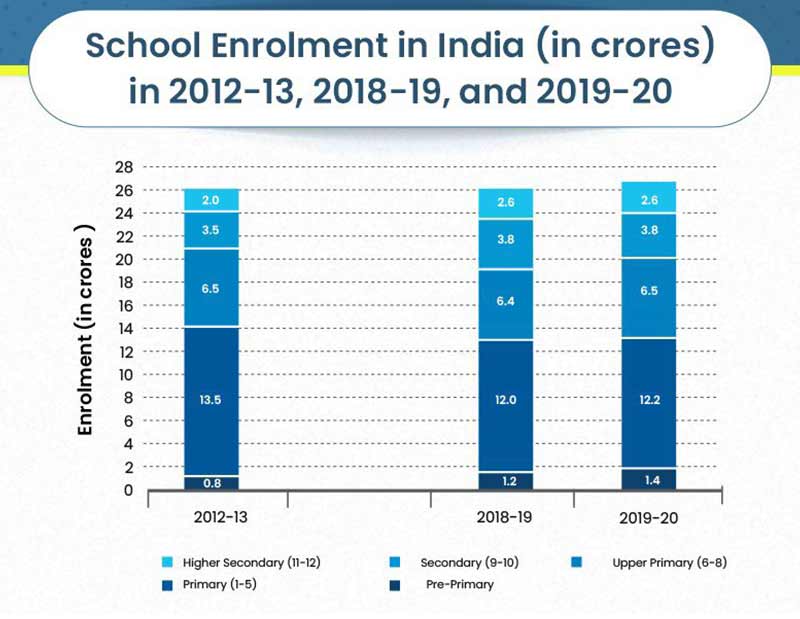
The Indian school education system is one of the largest in the world with more than 15 lakh schools, nearly 97 lakh teachers and nearly 26.5 crore students of pre-primary to higher secondary level from varied socio-economic backgrounds.
A robust, real time and credible information collection mechanism is an essential prerequisite for an objective evaluation of the system, based on which specific interventions for improvement can be designed.
The Unified District Information on School Education (UDISE) was initiated in 2012-13 by the ministry of education by integrating the District Information System for Education (DISE) and Secondary Education Management Information System (SEMIS).
The UDISE+ is an updated and improved version of the UDISE.
What are the main points of the report?
• A total of 26.45 crore students were enrolled in school education from pre-primary to higher secondary in 2019-20, up by 42.3 lakhs compared to 2018-19.
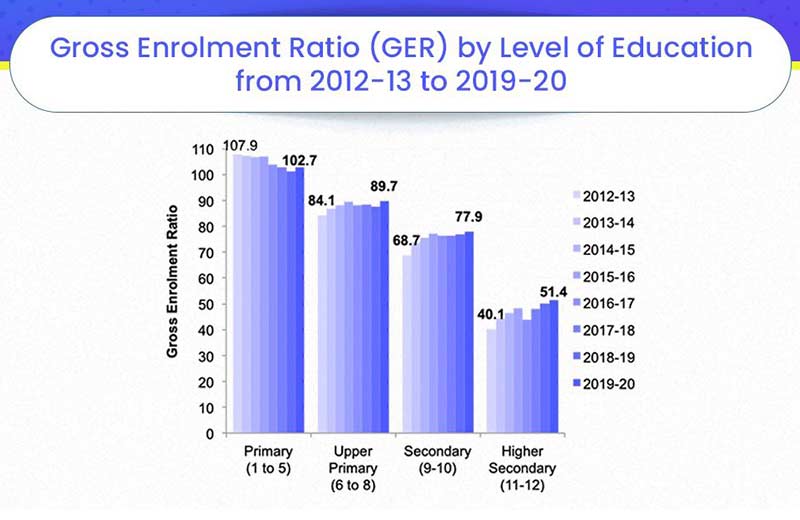
• The Gross Enrolment Ratio (GER) had improved in 2019-20 compared to 2018-19. The GER increased to 89.7 per cent (from 87.7 per cent) at upper primary level, 97.8 per cent (from 96.1 per cent) at elementary level, 77.9 per cent (from 76.9 per cent) at secondary level and 51.4 per cent (from 50.1 per cent) at higher secondary level in 2019-20.
• The Gross Enrolment Ratio (GER) compares the enrolment in a specific level of education to the population of the age group which is age-appropriate for that level of education. For example, the GER of primary is student enrolment in class 1 to 5 expressed as a percentage of population in age group 6-10 years.
• The overall dropout rate at the secondary level in the country is over 17 per cent, while in the upper primary classes (6 to 8) and the primary level it is 1.8 and 1.5 per cent respectively.
• The dropout rate for boys in primary classes was 1.7 per cent as against the girls’ 1.2 per cent. Similarly, the dropout rate for boys was higher in secondary classes (18.3 per cent) than girls (16.3 per cent).
• In upper primary classes, the dropout rate for boys (1.4 per cent) was less than that for girls (2.2 per cent).
• Nearly 30 per cent students in the country do not transition from the secondary to the senior secondary level.
• There are over 3.8 crore students enrolled at the secondary level, of whom 44.3 per cent are in government schools, a little over 20 per cent are with government-aided schools and nearly 35 per cent are with private-unaided schools.
• There are 19 states and UTs where the dropout rate at the secondary level (classes 9 and 10) is higher than the all-India rate (17.3 per cent), with states like Tripura, Sikkim, Nagaland, Meghalaya, Madhya Pradesh, Assam and Arunachal Pradesh having a dropout rate of over 25 per cent. There are four states that recorded a dropout rate of over 30 per cent.
• While a majority of the states from the northeastern and eastern regions have a high dropout rate, Delhi too has a dropout rate of over 20 per cent.
• Along with Punjab (which has the lowest dropout rate of 1.5 per cent), the states and UTs with a less than 10 per cent dropout rate are Chandigarh (9.5 per cent), Kerala (eight per cent), Manipur (9.6 per cent), Tamil Nadu (9.6 per cent) and Uttarakhand (9.8 per cent).
• Comparatively, these are also the states and UTs with the highest promotion rate at the secondary level, with Punjab, Manipur and Kerala having a promotion rate of over 90 per cent.
• The overall dropout rate of girls is two per cent less than that of the boys.
• Punjab registered a zero dropout rate for girls, while Assam recorded the highest dropout rate (35.2 per cent) at the secondary level.
• There are six states and Union territories where the dropout rate for boys is over 30 per cent. For states like Goa, the boys’ (21.2 per cent) dropout rate is nearly 10-per cent higher than that of the girls (11.8 per cent).
• As many as 96.87 lakh teachers have been engaged in school education, up by 2.57 lakh compared to 2018-19.
• More than 84 per cent schools had a library/reading room/reading corner in 2019-20, an improvement of nearly 4 per cent compared to the previous year.
Manorama Yearbook app is now available on Google Play Store and iOS App Store