
- India
- Jul 05
KVIC launches Project BOLD in Rajasthan
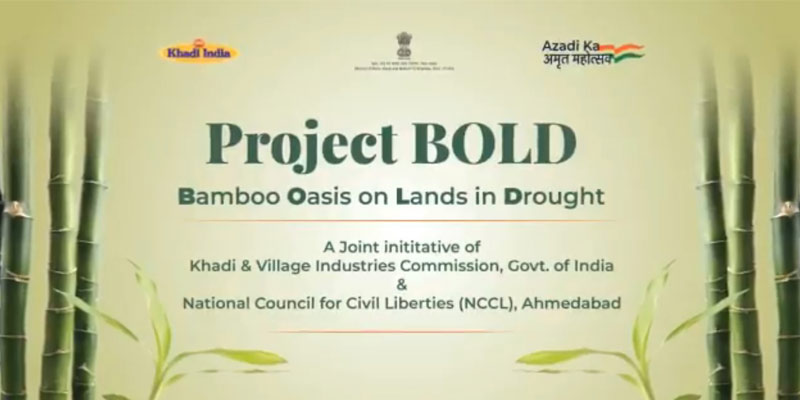
To reduce land desertification and provide livelihood, Khadi and Village Industries Commission (KVIC) initiated a project by planting 5,000 saplings of special bamboo species in Rajasthan.
The project named ‘Bamboo Oasis on Lands in Drought’ (BOLD) was launched from the tribal village Nichla Mandwa in Udaipur, Rajasthan.
What is Project BOLD?
• Project BOLD seeks to create bamboo-based green patches in arid and semi-arid land zones.
• It is aligned with PM Narendra Modi’s call for reducing land degradation and preventing desertification in the country.
• India is a signatory to the UN Convention to Combat Desertification (UNCCD). In his keynote address at the UN High-Level Dialogue on Desertification, Land Degradation and Drought on June 14, PM Modi gave a clarion call of restoring 26 million hectares of degraded land by 2030. This assumes great significance as nearly 30 percent of land in India is undergoing desertification at a rapid pace.
• Under Project BOLD, 5,000 saplings of special bamboo species — Bambusa Tulda and Bambusa Polymorpha brought from Assam — have been planted over 16 acres of vacant arid Gram Panchayat land.
• The initiative has been launched as part of KVIC’s ‘Khadi Bamboo Festival’ to celebrate 75 years of independence — Azadi ka Amrit Mahotsav.
• KVIC is set to replicate the project at Dholera village in Ahmedabad district in Gujarat and Leh-Ladakh region by August this year. Total 15,000 bamboo saplings will be planted before August 21.
• The green patches of bamboo on these three places — Udaipur, Ahmedabad and Ladakh — will help in reducing the land degradation percentage of the country, while on the other hand, they will be havens of sustainable development and food security.
Significance of bamboo plantation drive
• Bamboo plantation drive on such a large scale will create additional income for the local tribal population, while it will also support the local bamboo-based industries and thus boost the rural economy.
• Bamboo species Bambusa Tulda and Bambusa Plymorpha brought from Assam are used for making agarbatti sticks and making furniture/handicraft items, respectively.
• Bamboos grow very fast and in about three years’ time, they could be harvested, and income recorded.
• In these three years, the 5,000 bamboo plants will produce at least 20,000 bamboo logs weighing about 500 MT of bamboo. At the current market rate of Rs 5,000 per ton, this bamboo produce will generate an income of nearly Rs 25 lakh after three years and later on every year, thus supporting the local economy.
• These bamboo patches will be able to meet the bamboo requirement of agarbatti manufacturers in Rajasthan, Gujarat and Madhya Pradesh.
• Bamboo can be used for making agarbatti sticks, furniture, handicraft, musical instruments and paper pulp, while the bamboo waste is widely used in making charcoal and fuel briquettes.
• Bamboos are also known for conserving water and reducing evaporation of water from the land surface, which is an important feature in arid and drought-prone regions.
Manorama Yearbook app is now available on Google Play Store and iOS App Store