
- India
- Oct 07
Union Cabinet approves Rs 4,445 crore PM MITRA scheme
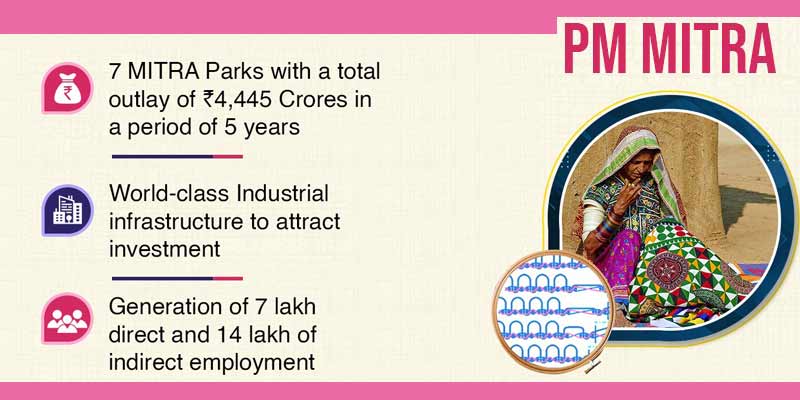
• The Union Cabinet approved setting up of seven Mega Integrated Textile Region and Apparel (PM MITRA) parks with a total outlay of Rs 4,445 crore for five years.
• PM MITRA parks were announced in the Union Budget for 2021-22.
• This will enhance the competitiveness of the textiles industry, by helping it in achieving economies of scale and will create huge job opportunities for millions of people.
• Union Textiles Minister Piyush Goyal said the parks will create direct employment for 7 lakh people and indirect employment for 14 lakh people.
• Leveraging economies of scale, the scheme will help Indian companies to emerge as global champions.
How will the parks be developed?
• The parks will be developed by a Special Purpose Vehicle (SPV), which will be owned by the state government and the central government through a Public Private Partnership (PPP) mode.
• The master developer will not only develop the industrial park but also maintain it during the concession period. Selection of this master developer will happen based on objective criteria developed jointly by state and central governments.
• The SPV, in which the state government has a majority ownership, will be entitled to receive part of the lease rental from developed industrial sites and will be able to use that for further expansion of the textiles industry in the area by expanding the PM-MITRA park, providing skill development initiatives and other welfare measures for workers.
• The parks will be set up at greenfield/brownfield sites located in different states.
• Goyal said 10 states have already shown interest in setting up the parks. The states are Tamil Nadu, Punjab, Odisha, Andhra Pradesh, Gujarat, Rajasthan, Assam, Madhya Pradesh, Karnataka and Telangana.
• Under PM-MITRA, 50 per cent area will be developed for pure manufacturing activity, 20 per cent area for utilities, and 10 per cent of the area for commercial development.
• The parks will offer an opportunity to create an integrated textiles value chain right from spinning, weaving, processing/dyeing and printing to garment manufacturing at one location.
• An integrated textile value chain at one location will also reduce the logistics cost of the industry.
• Maximum Development Capital Support (DCS) of Rs 500 crore to all greenfield parks and a maximum of Rs 200 crore to brownfield ones will be provided for the development of common infrastructure (30 per cent of the project cost).
• Also, Rs 300 crore of Competitiveness Incentive Support (CIS) will be provided to each park for the early establishment of textiles manufacturing units. It will be paid up to 3 per cent of turnover of a newly established unit in PM MITRA park. Such support is crucial for a new project which has not been able to break even and needs support till it is able to scale up production and be able to establish its viability.
Manorama Yearbook app is now available on Google Play Store and iOS App Store