
- India
- Oct 28
India successfully test-fires Agni-5 missile
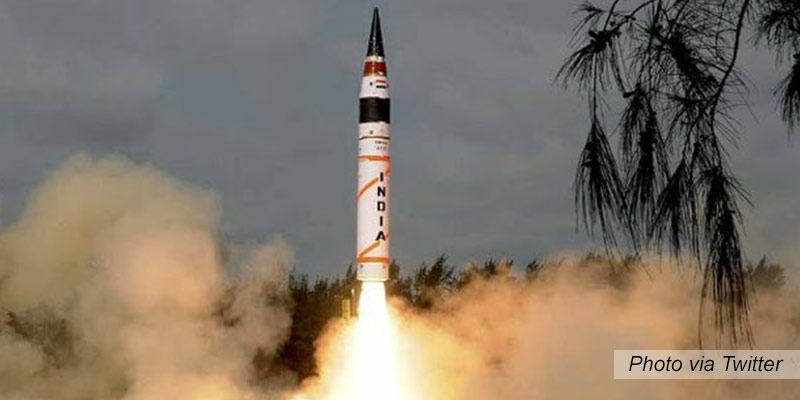
• India successfully test-fired surface-to-surface strategic missile Agni-5 that can strike targets at ranges up to 5,000 km with a very high degree of accuracy.
• The test-firing of the nuclear-capable missile was carried out from the APJ Abdul Kalam Island in Odisha.
• The successful test-firing of the missile, built by the Defence Research Development Organisation (DRDO), came amid a lingering border standoff with China in eastern Ladakh.
• The Agni-5 project is aimed at enhancing India’s nuclear deterrence against China which has missiles like Dongfeng-41 having ranges between 12,000-15,000 km.
• The work on the Agni-5 intercontinental ballistic missile project was started over a decade ago and the missile was tested seven times before.
• The first test of the missile was carried out in April 2012 while the previous one was conducted around three years ago.
• The missile, which uses a three-stage solid-fuelled engine, is capable of striking targets at ranges up to 5,000 kilometres with a very high degree of accuracy.
• The Agni 1 to 4 missiles have ranges from 700 km to 3,500 km and they have already been deployed. The Agni-5 project was aimed at enhancing India’s nuclear deterrence against China.
• The successful test of Agni-5 is in line with India’s stated policy to have credible minimum deterrence that underpins the commitment to ‘No First Use’.
• In June, the DRDO successfully test-fired a new generation of ‘Agni’ class nuclear-capable ballistic missile that has a range of up to 2,000 km.
Manorama Yearbook app is now available on Google Play Store and iOS App Store