
- India
- Feb 17
PM Modi inaugurates TERI’s World Sustainable Development Summit
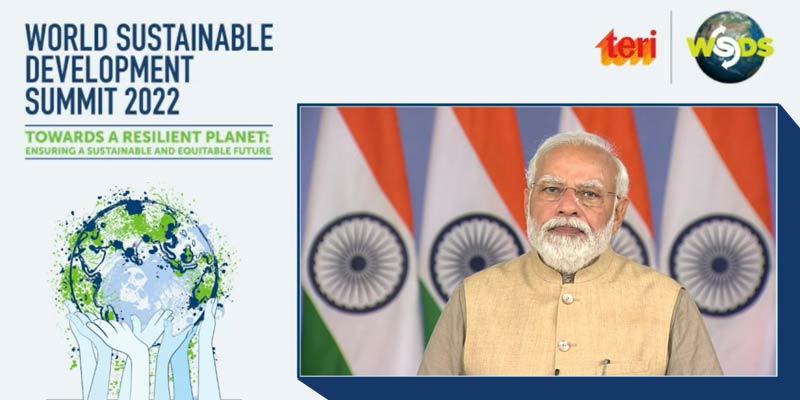
Prime Minister Narendra Modi delivered the inaugural address of The Energy and Resources Institute’s (TERI) World Sustainable Development Summit 2022.
What is the purpose of TERI?
• The Energy and Resources Institute (TERI) is an independent, multi-dimensional organization, with expertise in research, policy, consultancy and implementation.
• TERI, established in 1974, researches and provides knowledge to governments and international institutions in the areas of energy, environment, forestry, biotechnology, as well as in the conservation of natural resources.
• It has innovators and agents of change in the energy, environment, climate change and sustainability spheres, having pioneered conversations and action in these areas for over four decades.
TERI’s work across sectors is focused on:
i) Promoting efficient use of resources.
ii) Increasing access and uptake of sustainable inputs and practices.
iii) Reducing negative impact on environment and climate.
• TERI’s research and research-based solutions have had a transformative impact on industries and communities. It has fostered international collaboration on sustainability action by creating a number of platforms and fora. Research gets translated into technology products, technical services, as well as policy advisory and outreach.
• Headquartered in New Delhi, TERI has regional centres and campuses in Gurugram, Bengaluru, Guwahati, Mumbai, Panaji and Nainital.
• A team of over 1,200 scientists, sociologists, economists, and engineers engages in and implements insightful, high quality action-oriented research and transformative solutions supported by the state-of-the-art infrastructure.
The World Sustainable Development Summit
• The World Sustainable Development Summit (WSDS) is the annual flagship Track II initiative of TERI. The Summit platform, instituted in 2001, has brought together thought leaders, heads of state and government, scholars, corporates, youth groups, and civil society representatives from across the world.
• The Summit series has established itself as a responsible and an effective platform for mobilising opinion-makers to identify and advance pioneering actions to address some of the most relevant issues concerning sustainable development.
• Over the years, the Summit series has brought together 52 Heads of State and government, 13 Nobel Laureates, 78 ministers, 1,827 business leaders, 2,418 speakers, and 26,091 delegates.
• The 21st Edition of the annual flagship event is organised from February 16-18, 2022 in a virtual format.
• The Summit deliberations will focus on the umbrella theme: ‘Towards a Resilient Planet: Ensuring a Sustainable and Equitable Future’.
Key points of PM Modi’s speech:
• Energy requirements of the people of India are expected to double in the next 20 years. Denying this energy would be denying life itself to millions. Successful climate action also needs adequate financing. For this, developed countries need to fulfil their commitments on finance and technology transfer.
• India believes in fulfilling commitments under the United Nation Framework Convention on Climate Change (UNFCCC) and the country has raised its ambitions during COP26 at Glasgow.
Through the International Solar Alliance, our aim is One Sun, One World, One Grid. We must work towards ensuring availability of clean energy from a worldwide grid everywhere at all times. This is the ‘whole of the world’ approach that India’s values stand for.
• With 2.4 per cent of the world’s land area, India accounts for nearly 8 per cent of the world’s species. It is our duty to protect this ecology. We are strengthening our protected area network.
• The Aravalli Biodiversity Park in Haryana being declared as Other Effective Area-based Conservation Measures (OECM) site for its effective conservation of biodiversity. India now has 49 Ramsar Sites spread over more than 1 million hectares. Restoring degraded land has been one of our main focus areas. Since 2015, we have restored more than 11.5 million hectares. We are on track to achieve the national commitment of Land Degradation Neutrality under the Bonn Challenge.
• Equitable energy access to the poor has been a cornerstone of our environmental policy. Through Ujjwala Yojana, more than 90 million households have been provided access to clean cooking fuel. Under the PM-KUSUM scheme, we have taken renewable energy to farmers. We are encouraging farmers to set up solar panels, use them and sell surplus power to the grid.
• Stand-alone solar pumps as well as efforts for solarising existing pumps are being scaled up, adding the focus on ‘chemical-free natural farming’ will also help promote sustainability and equity.
• The LED bulbs distribution scheme has been running for over seven years and has helped save over 220 billion units of electricity and 180 billion tonnes of carbon dioxide emissions per year.
• The National Hydrogen Mission which aims to tap into green hydrogen, an exciting technology to power the future.
Manorama Yearbook app is now available on Google Play Store and iOS App Store