
- India
- Jul 18
Over 99% turnout in the 16th presidential polls
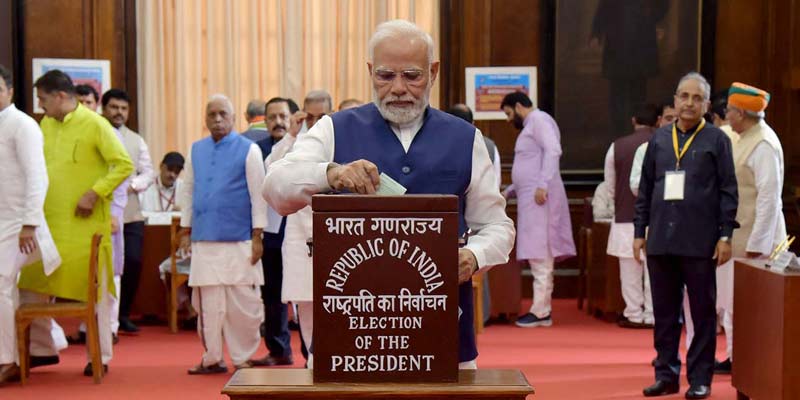
Parliamentarians and legislators across the country voted to elect India’s next President.
The BJP-led NDA had nominated Droupadi Murmu as its candidate, while the joint opposition had fielded Yashwant Sinha for the 16th presidential election.
The Election Commission said over 99 per cent of the total 4,796 electors cast their votes in the presidential poll, while 10 states and the Union Territory of Puducherry recorded a turnout of 100 per cent.
The votes will be counted on July 21 and the next President will take oath on July 25.
Election process
• The Office of the President is the highest elective office in the country.
• Under Article 324 of the Constitution of India, the authority to conduct elections to the Office of President is vested in the Election Commission of India.
• As per Article 62 of the Constitution of India, an election to fill the vacancy caused by the expiration of the term of office of the outgoing President is required to be completed before the expiration of the term.
• As per the Article 54 of the Constitution the President is elected by the members of the electoral college consisting of elected members of both Houses of Parliament, and elected members of the legislative Assemblies of all states including the National Capital Territory of Delhi and the Union Territory of Puducherry.
• The nominated members of either Rajya Sabha and Lok Sabha or legislative Assemblies of the states are not eligible to be included in the electoral college and therefore, they are not entitled to participate in the election.
• Similarly, members of the Legislative Councils are also not electors for the presidential election.
• There were a total of 4,796 electors in the list of electoral college to participate in the election.
• The election was concluded successfully at the Parliament House and at 30 centres within State Legislative Assemblies across the country, including in Delhi and Puducherry.
• Polling was held between 10am to 5pm at the 31 locations.
• A 100 per cent voting by MLAs was reported from Chhattisgarh, Goa, Gujarat, Himachal Pradesh, Kerala, Karnataka, Madhya Pradesh, Manipur, Sikkim, Tamil Nadu and Puducherry.
• As many as 44 MPs were permitted to vote at state headquarters, nine MLAs at Parliament House and two MLAs in other states’ headquarters.
Manorama Yearbook app is now available on Google Play Store and iOS App Store