
- India
- Oct 26
Explainer / Solar eclipse
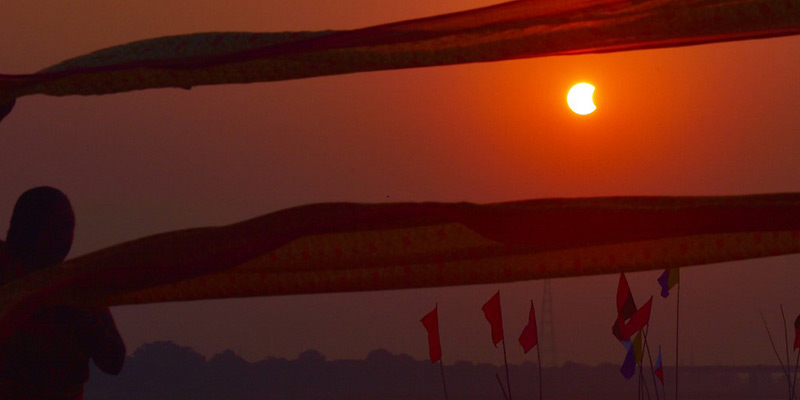
• A partial solar eclipse on October 25 enthralled stargazers, who pointed their telescopes towards the Sun to watch the celestial tango.
• Astronomical telescopes at Hanle in Ladakh, Naintal in Uttarakhand and several amateur and professional astronomers watched the eclipse that began at 4:17 pm as the Moon started covering the solar disc.
• Astronomy clubs set up public viewing of the eclipse at several locations across the country and even distributed special eyewear to watch the eclipse.
• The partial solar eclipse was observed in several parts of the country with Srinagar witnessing the maximum obscuration of the solar disc at 55 per cent. In Delhi 43 per cent of the solar disc was covered by the shadow of the moon, Jammu (52 per cent), Bengaluru (9.9 per cent), Kochi (5.1 per cent).
• The next solar eclipse will be visible from India on August 2, 2027.
What is solar eclipse?
• Solar eclipse occurs when the Sun, the Moon, and Earth line up, either fully or partially. Depending on how they align, eclipses provide a unique, exciting view of either the Sun or the Moon.
• A solar eclipse happens when the Moon passes between the Sun and Earth, casting a shadow on Earth that either fully or partially blocks the Sun’s light in some areas. This only happens occasionally, because the Moon doesn’t orbit in the exact same plane as the Sun and Earth do.
• Eclipses have driven numerous scientific discoveries. For over a century, solar eclipses helped scientists decipher the Sun’s structure and explosive events, find evidence for the theory of general relativity, discover a new element, and much more.
Types of solar eclipses
There are four types of solar eclipses: total, partial, hybrid, and annular. The type of eclipse that people get to see depends on how the Moon aligns with Earth and the Sun, and how far away the Moon is from Earth.
i) Total Solar Eclipse: A total solar eclipse happens when the Moon passes between the Sun and Earth, completely blocking the face of the Sun. People located in the center of the Moon’s shadow when it hits Earth will experience a total eclipse. The sky will darken, as if it were dawn or dusk.
ii) Partial Solar Eclipse: A partial solar eclipse happens when the Moon passes between the Sun and Earth but the Sun, Moon, and Earth are not perfectly lined up. Only a part of the Sun will appear to be covered, giving it a crescent shape.
iii) Annular Solar Eclipse: An annular solar eclipse happens when the Moon passes between the Sun and Earth, but when it is at or near its farthest point from Earth. Because the Moon is farther away from Earth, it appears smaller than the Sun and does not completely cover the Sun. As a result, the Moon appears as a dark disk on top of a larger, bright disk, creating what looks like a ring around the Moon.
iv) Hybrid Solar Eclipse: Because Earth’s surface is curved, sometimes an eclipse can shift between annular and total as the Moon’s shadow moves across the globe. This is called a hybrid solar eclipse.
Manorama Yearbook app is now available on Google Play Store and iOS App Store