
- India
- Apr 27
Cabinet approves National Medical Devices Policy 2023
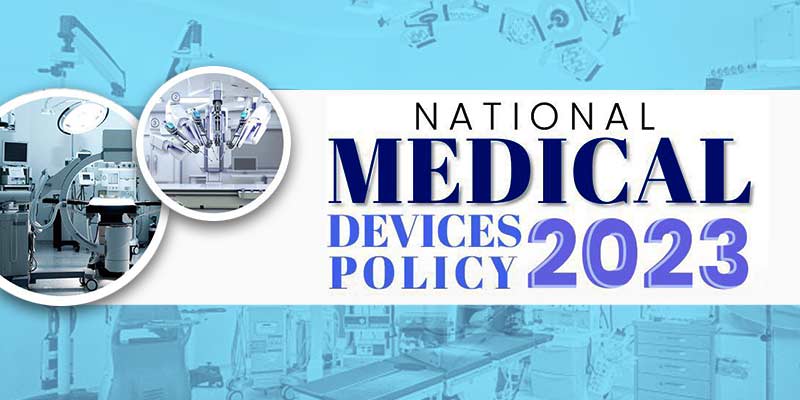
The Union Cabinet approved National Medical Devices Policy 2023 on April 26 to promote domestic manufacturing.
Indian medical device market
• The medical devices sector in India is an essential and integral constituent of the Indian healthcare sector, particularly for the prevention, diagnosis, treatment and management of all medical conditions and disabilities.
• It forms an important pillar in the healthcare delivery system along with healthcare providers, pharmaceuticals and healthcare insurance industry.
• Medical devices are a sunrise sector of the Indian economy. The size of the Indian medical devices market is estimated at $11 billion (Rs 90,000 crore) in 2022, and is expected to grow to $50 billion by 2030.
• The export of medical devices sector has been growing at a CAGR of 9.37 per cent over the last five years.
• The Indian medical device market share in the global market is estimated to be 1.65 per cent.
• India is counted amongst the top 20 global medical devices market and is the fourth largest medical devices market in Asia after Japan, China, and South Korea.
The need for medical devices policy
• The policy is expected to provide the required support and directions to strengthen the medical devices industry into a competitive, self-reliant, resilient and innovative industry that caters to the healthcare needs of India and the world.
• The policy aims to place the medical devices sector on an accelerated path of growth with a patient-centric approach to meet the evolving healthcare needs of patients.
• While various government departments have undertaken programmatic interventions to encourage the sector, the current policy aims to put in place a comprehensive set of focus areas for the growth of the sector in a coordinated manner.
• The policy is expected to facilitate an orderly growth of the medical device sector to meet the public health objectives of access, affordability, quality and innovation.
Policy focuses on six strategies
Medical devices sector will be facilitated and guided through a set of strategies that will be cover six broad areas of policy interventions:
They are:
i) Regulatory Streamlining: In order to enhance ease of doing research and business and further to balance patient safety with product innovation measures such as creation of a Single Window Clearance System for Licensing of Medical Devices co-opting all the stakeholder departments/organisations, enhancing the Role of Indian Standards like Bureau of Indian Standards (BIS) and designing a coherent pricing regulation, will be followed.
ii) Enabling Infrastructure: The establishment and strengthening of large medical device parks, clusters equipped with world class common infrastructure facilities in proximity to economic zones with requisite logistics connectivity as envisioned under the National Industrial Corridor Programme and the proposed National Logistics Policy 2021 under the ambit of PM GatiShakti, would be pursued with the state governments and industry for better convergence and backward integration with medical device industry.
iii) Facilitating R&D and Innovation: The policy envisages to promote research & development in India and complement the department’s proposed National Policy on R&D and Innovation in the pharma-medtech sector in India. It also aims at establishing Centres of Excellence in academic and research institutions, innovation hubs, ‘plug and play’ infrastructures and support to startups.
iv) Attracting Investments in the Sector: Along with recent schemes and interventions like Make in India, Ayushman Bharat programme, Heal in India, Startup mission, the policy encourages private investments, series of funding from venture capitalists, and also public-private partnership (PPP).
v) Human Resources Development: In order to have a steady supply of skilled workforce across the value chain such as scientists, regulators, health experts, managers, technicians, etc, the policy envisages:
• For skilling, reskilling and upskilling of professionals in the medical device sector, we can leverage the available resources in the ministry of skill development and entrepreneurship.
• The policy will support dedicated multidisciplinary courses for medical devices in existing institutions to ensure availability of skilled manpower for futuristic medical technologies, high-end manufacturing and research, to produce future-ready medtech human resources and to meet the evolving needs of the sector.
• To develop partnerships with foreign academic/industry organisations to develop medical technologies in order to be at an equal pace with the world market.
vi) Brand Positioning and Awareness Creation: The policy envisages the creation of a dedicated Export Promotion Council for the sector under the Department which will be an enabler to deal with various market access issues:
• Initiate studies and projects for learning from best global practices of manufacturing and skilling system so as to explore the feasibility of adapting such successful models in India.
• Promote more forums to bring together various stakeholders for sharing knowledge and build strong networks across the sector.
Manorama Yearbook app is now available on Google Play Store and iOS App Store