
- India
- Sep 07
PM Modi attends 20th ASEAN-India Summit in Jakarta
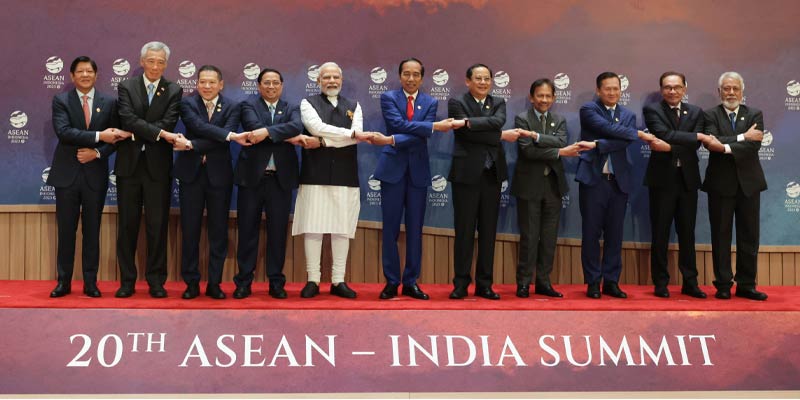
• Prime Minister Narendra Modi attended the 20th ASEAN-India Summit in Jakarta on September 7.
• PM Modi held extensive discussions with ASEAN partners on further strengthening of ASEAN-India Comprehensive Strategic Partnership and charting its future course.
• He reaffirmed ASEAN centrality in the Indo-Pacific and highlighted the synergies between India’s Indo-Pacific Ocean's Initiative (IPOI) and ASEAN’s Outlook on the Indo-Pacific (AOIP).
• He also emphasized the need to complete the review of ASEAN-India FTA (AITIGA) in a time bound manner.
• PM Modi presented a 12-point proposal for strengthening India-ASEAN cooperation covering connectivity, digital transformation, trade and economic engagement, addressing contemporary challenges, people-to-people contacts and deepening strategic engagement.
They are:
i) Establishing a multi-modal connectivity and economic corridor that links India, Southeast Asia, West Asia and Europe.
ii) Offered to share India’s Digital Public Infrastructure Stack with ASEAN partners.
iii) Announced ASEAN-India fund for digital future focusing on cooperation in digital transformation and financial connectivity.
iv) Announced renewal of support to Economic and Research Institute of ASEAN and East Asia (ERIA) to act as knowledge partner for enhancing our engagement.
v) Called for collectively raising issues being faced by Global South in multilateral fora.
vi) Invited ASEAN countries to join Global Centre for Traditional Medicine being established by WHO in India.
vii) Called for working together on Mission LiFE.
viii) Offered to share India’s experience in providing affordable and quality medicines to people through Jan Aushadhi Kendras.
ix) Called for collective fight against terrorism, terror financing and cyber-disinformation.
x) Invited ASEAN countries to join the Coalition for Disaster Resilient Infrastructure.
xi) Called for cooperation in disaster management.
xii) Called for enhanced cooperation on maritime safety, security and domain awareness.
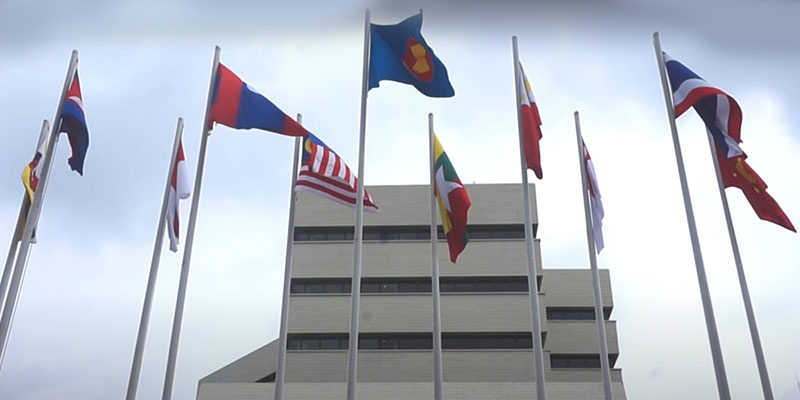
What is ASEAN?
• The Association of Southeast Asian Nations (ASEAN) was established on August 8, 1967 in Bangkok by five countries — Indonesia, Malaysia, Philippines, Singapore, and Thailand.
• There are currently 10 member states: Indonesia, Malaysia, Philippines, Singapore, Thailand, Brunei, Laos, Myanmar, Cambodia and Vietnam.
• In November 2022, ASEAN announced that it has agreed in principle to admit East Timor, also known as Timor-Leste, as the group’s 11th member. The half-island nation will also be granted observer status at high-level ASEAN meetings.
• The ASEAN Summit is the highest policy-making body in ASEAN comprising the heads of State or government of ASEAN member states. As per regular practice, the ASEAN Summit Meetings shall be held twice annually. The first ASEAN Summit was held in Bali, Indonesia on February 23-24, 1976.
• ASEAN is considered one of the most influential groupings in the region. India and several other countries, including the US, China, Japan and Australia, are its dialogue partners.
The aims and purposes of ASEAN are:
i) Accelerate the economic growth, social progress and cultural development in the region through joint endeavors in the spirit of equality and partnership in order to strengthen the foundation for a prosperous and peaceful community of Southeast Asian Nations.
ii) Promote regional peace and stability through abiding respect for justice and the rule of law in the relationship among countries of the region and adherence to the principles of the United Nations Charter.
iii) Promote active collaboration and mutual assistance on matters of common interest in the economic, social, cultural, technical, scientific and administrative fields.
iv) Provide assistance to each other in the form of training and research facilities in the educational, professional, technical and administrative spheres.
v) Collaborate more effectively for the greater utilisation of their agriculture and industries, the expansion of their trade, including the study of the problems of international commodity trade, the improvement of their transportation and communications facilities and the raising of the living standards of their peoples.
vi) Promote Southeast Asian studies.
vii) Maintain close and beneficial cooperation with existing international and regional organisations with similar aims and purposes, and explore all avenues for even closer cooperation among themselves.
India-ASEAN relations
• ASEAN centrality has been, and will remain, an important aspect of India’s ‘Act East’ policy which is a central element in the country’s foreign policy.
• ASEAN-India dialogue relations have grown rapidly from a sectoral dialogue partnership in 1992 to a full dialogue partnership in December 1995. The relationship was further elevated with the convening of the ASEAN-India Summit in 2002 in Phnom Penh, Cambodia. Since then the ASEAN-India Summit has been held annually.
• At the ASEAN-India Commemorative Summit held in December 2012 in New Delhi, the leaders adopted the ASEAN-India Vision Statement and declared that the ASEAN-India Partnership stands elevated to a ‘Strategic Partnership’.
• In 2022, ASEAN-India relations were elevated to ‘Comprehensive Strategic Partnership’, that is meaningful, substantive and mutually beneficial.
• India and ASEAN registered a bilateral trade of $131.5 billion in 2022-23. The trade with ASEAN accounted for 11.3 per cent of India’s global trade in 2022-23.
• The collaboration has transcended the realm of functional cooperation to cover political and security dimensions. India participates in a series of consultative meetings with ASEAN under the ASEAN-India Dialogue Relations, which include Summit, ministerial meetings, senior officials meetings, and meetings at experts level, as well as through dialogue and cooperation frameworks initiated by ASEAN, such as the ASEAN Regional Forum (ARF), the Post Ministerial Conference (PMC) 10+1, the East Asia Summit (EAS), Mekong-Ganga Cooperation and Bengal Initiative for Multisectoral Technical and Economic Cooperation (BIMSTEC), which help contribute to enhancing regional dialogue and accelerating regional integration.
• India’s bilateral trade with ASEAN economies is expected to reach $300 billion by 2025, and it is the fifth largest trading partner for India following North America, EU, North-East Asia and GCC-West Asia.
• The ASEAN-India Free Trade Area has been completed with the entering into force of the ASEAN-India Agreements on Trade in Service and Investments on July 1, 2015.
Manorama Yearbook app is now available on Google Play Store and iOS App Store