
- India
- Jan 24
India supplies insecticide to Afghanistan to combat locust threat
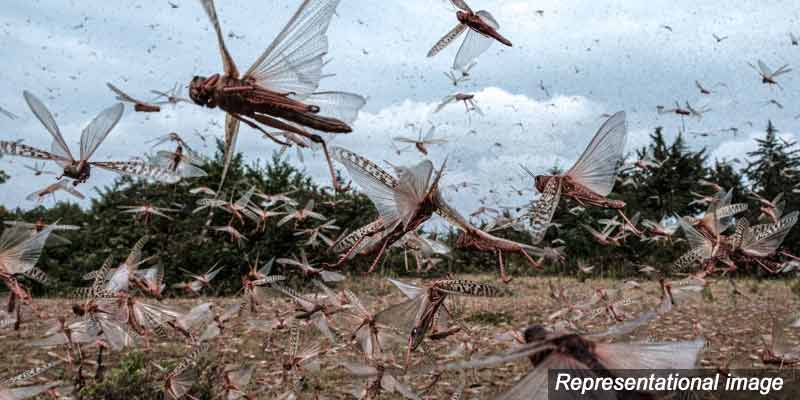
• India supplied 40,000 liters of malathion pesticide to Afghanistan to fight locust menace.
• Malathion pesticide was supplied in two trucks and officially handed over to the Taliban-controlled Afghanistan government.
• Malathion, known for its efficacy in arid regions and minimal water usage, is considered a crucial tool in locust control.
• The assistance not only helps in preventing locusts in Afghanistan, but also prevents locusts from Central Asian countries, especially Tajikistan, Uzbekistan and Turkmenistan, and is effective on crops in the region.
What is malathion?
• Malathion is an organophosphate (OP) insecticide.
It is used:
i) In the agricultural production of a wide variety of food and feed crops to control many types of insects.
ii) By home gardeners for outdoor residential uses including vegetable gardens, fruit trees, and a variety of ornamentals.
iii) In public health pest control programmes for controlling mosquito-borne illnesses.
What are locusts?
• Locusts are the oldest migratory pests in the world.
• They are capable of forming swarms. They cause great devastation to natural and cultivated vegetation.
• They are indeed the sleeping giants that can flare up any time to inflict heavy damage to crops, leading to national emergency of food and fodder.
• Locust swarms can fly up to 150 km a day with the wind.
• Locusts are part of a large group of insects commonly called grasshoppers. However, locusts differ from grasshoppers in that they have the ability to change their behaviour and habits and can migrate over large distances.
• The magnitude of the damage and loss caused by locusts is gigantic as they have caused starvation.
• On average, a small locust swarm eats as much food in one day as about 10 elephants, 25 camels or 2,500 people. Locusts cause damage by devouring leaves, flowers, fruits, seeds, bark and growing points and also by breaking down trees because of their weight when they settle down in masses.
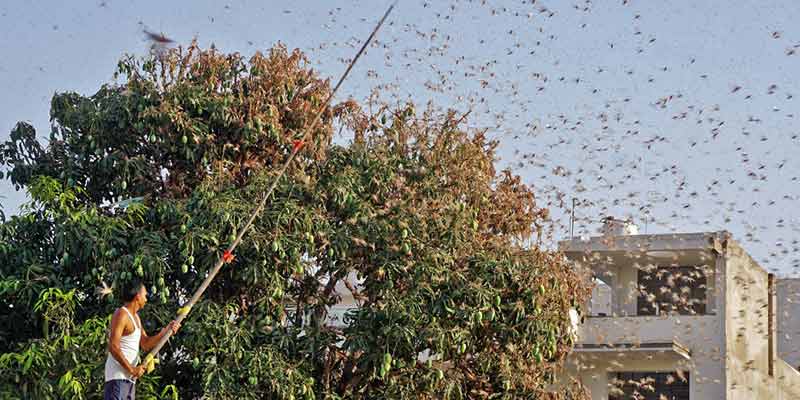
Locust attacks in India
• Four species are found in India — desert locust (Schistocerca gregaria), migratory locust (Locusta migratoria), Bombay locust (Nomadacris succincta) and tree locust (Anacridium spp).
• The desert locust is the most important pest species in India as well as in intercontinental context.
• Major incursions of locust swarms were noticed during 1926-31, 1940-46, 1949-55 and the last locust cycle in India was during 1959-62.
• During 2019-20, India witnessed a massive locust attack which was successfully controlled.
• Starting from May 21, 2019 till February 17, 2020, a total of 4,03,488 hectare area was treated and locust swarms were controlled.
• Usually, the locust swarms enter the scheduled desert area of India through Pakistan for summer breeding in the month of June/July with the advent of monsoon.
Manorama Yearbook app is now available on Google Play Store and iOS App Store