
- India
- Aug 26
- Kevin Savio Antony
India, Australia hold 10th round of CECA talks
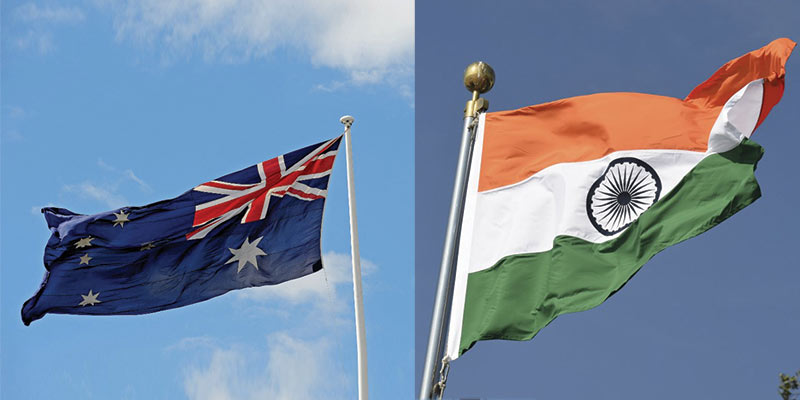
• Senior officials of India and Australia are expected to hold their next round of talks for Comprehensive Economic Cooperation Agreement (CECA) in November in New Delhi.
• The two countries implemented an interim trade agreement in December 2022 and are now under negotiations to expand its scope.
• The tenth round of India-Australia CECA negotiations was held in Sydney from August 19-22 in the areas of goods, services, digital trade, government procurement, rules of origin and agri-tech.
• Both sides made efforts to ensure that the CECA negotiation delivers meaningful benefits and balanced outcome for both sides.
• Australia is an important trade and strategic partner of India. Both the countries are part of the 14 country Indo-Pacific Economic Forum for Prosperity (IPEF) and trilateral Supply Chain Resilience Initiative (SCRI) which is expected to strengthen the supply chain resilience in the region.
• In addition to the trade talks, the Australian side proposed to hold the first meeting of the India-Australia Agri Tech Forum (IAATF), a newly constituted forum by Australia, in New Delhi on September 23, 2024, with the Indian agricultural stakeholders namely industry, research institutions and government for building on mutually beneficial relationship by exploring opportunities for focused activity around technology transfer and knowledge sharing in agriculture and horticulture sectors.
India-Australia CECA negotiations
• India is Australia’s sixth largest trading partner with two-way trade in goods and services valued at $46.5 billion in 2022.
• Australia and India first launched negotiations for a Comprehensive Economic Cooperation Agreement (CECA) in May 2011.
• In June 2020, as part of the joint statement on a ‘Comprehensive Strategic Partnership’ between India and Australia, Prime Minister Narendra Modi and his Australian counterpart Scott Morrison decided to re-engage on a bilateral CECA while suitably considering earlier bilateral discussions, where a mutually agreed way forward can be found.
• Recent years have seen remarkable growth in the trading relationship between India and Australia, fuelled by the many complementarities between the two economies.
• India mainly exports refined petroleum, medicaments, railway vehicles including hovertrains, pearls and gems, jewellery, and made-up textile articles. While imports include coal, copper ores and concentrates, gold, vegetables, wool, fruits and nuts, lentils, and education-related services.
• The CECA pact between the two countries is anticipated to provide enhanced market access, affecting various sectors such as digital trade, goods and services, rules of origin, government procurement, and broader areas of cooperation.
India-Australia Relations
• India and Australia established diplomatic relations in the pre-Independence period, with the establishment of India Trade Office in Sydney in 1941.
• The end of the Cold War and simultaneously India’s decision to launch major economic reforms in 1991 provided the first positive move towards development of closer ties between the two nations.
• Both countries upgraded bilateral relationship from ‘Strategic Partnership’ in 2009 to Comprehensive Strategic Partnership (CSP) in 2020.
• India and Australia are partners in the trilateral Supply Chain Resilience Initiative (SCRI) arrangement along with Japan which seeks to enhance the resilience of supply chains in the Indo-Pacific Region.
• Further, India and Australia are also members of the Quad, also comprising the US, and Japan, to further enhance cooperation and develop partnership across several issues of common concern.
Shared Values:
• The India-Australia bilateral relationship is underpinned by shared values of a pluralistic, Westminster-style democracies, Commonwealth traditions, expanding economic engagement and increasing high level interaction.
• The longstanding people-to-people ties, ever increasing Indian students coming to Australia for higher education, growing tourism, and sporting links, especially cricket and hockey, have played a significant role in further strengthening bilateral relations between the two countries.
Defence Cooperation
• The inaugural India-Australia 2+2 Ministerial Dialogue was held on September 11, 2021 and the Deputy Prime Minister and Defence Minister of Australia visited India in June 2022.
• India and Australia signed an agreement concerning Mutual Logistics Support to increase military interoperability through defence exercises between the two countries. The agreement allows the two countries to access military bases for logistics support.
Joint military exercises:
• Indian Navy’s indigenous frontline warships INS Sahyadri and INS Kolkata participated in Exercise MALABAR 2023 scheduled at Sydney along with ships and aircraft from the US Navy (USN), Japan Maritime Self Defence Force (JMSDF) and the Royal Australian Navy (RAN).
• Australia has invited India to be an active participant in its largest biennial multinational exercise — Talisman Sabre — scheduled for 2025.
(The author is a trainer for Civil Services aspirants.)