
- India
- Sep 09
- Kevin Savio Antony
India to bid for 2030 Youth Olympics
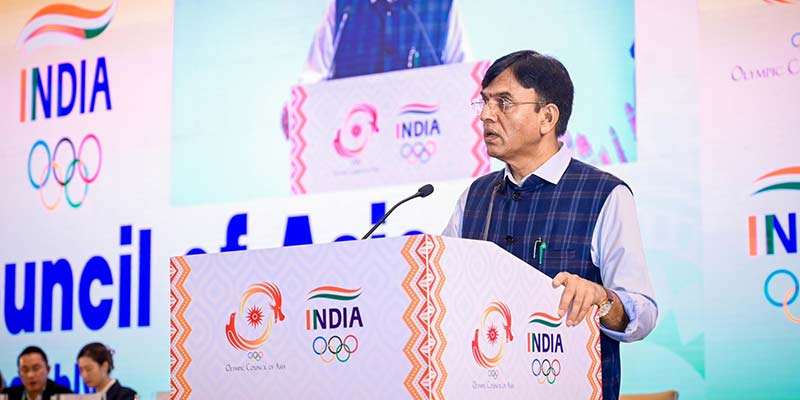
• Sports Minister Mansukh Mandaviya said India is set to bid for the 2030 Youth Olympics, a precursor to the country's ambition to host the 2036 Olympics.
• The 2030 Youth Olympics will be the fifth edition of the international event.
• India will fight against Peru, Colombia, Mexico, Thailand, Mongolia, Russia, Ukraine, Bosnia and Herzegovina to get the hosting rights for the 2030 Youth Olympics.
• Mandaviya informed the delegates about the various initiatives emphasized the pivotal role of government programmes like ‘Khelo India,’ ‘Target Olympic Podium Scheme (TOPS),’ and ‘Achieving Sports Milestone by Inspiring Women Through Action (ASMITA)’ in elevating sports standards nationwide.
What is Youth Olympic Games?
• The Youth Olympic Games (YOG) is a sporting event for young people aged from 15 to 18 from all over the world.
• The sports programme is mainly based on that of the Olympic Games. In addition, it includes exciting new sports, disciplines and formats, such as breaking, sport climbing, 3x3 basketball, 3x3 ice hockey and mixed gender and mixed National Olympic Committee (NOC) events.
• The YOG was first mooted in 2001 by International Olympic Committee (IOC) president Jacques Rogge, and approved in 2007 by IOC members.
• Like the Olympics Games, the YOG is held every four years.
Previous editions of Youth Olympic Games:
• 2010 - Singapore
• 2014 - Nanjing, China
• 2018 - Buenos Aires, Argentina
• 2026 - Dakar, Senegal.
What is Khelo India Programme?
• The Khelo India Scheme is the flagship Central Sector Scheme of the Ministry of Youth Affairs & Sports.
• It aims to foster a mass movement for promoting sports excellence across the country. With an annual budget of $119 million, the scheme covers grassroots talent identification and development, and provides scholarships to more than 2,700 children each year.
• Four Khelo India Games are conducted annually, with over 1,050 district-level centres established to develop sustainable sports infrastructure and provide training, accommodation, diet, education, and allowances to young athletes.
• Under this movement, the Khelo India Youth Games (KIYG), the Khelo India University Games (KIUG) and the Khelo India Winter Games (KIWG) were set up as annual national sports competitions where youngsters, representing their states and universities, respectively, showcased their skills and competed for medals.
Components of the Scheme:
It has been divided into various verticals:
i) State Level Khelo India Centres
ii) Annual sports competition
iii) Talent search and development
iv) Utilisation and creation/upgradation of sports
v) Support to national/regional/state sports academics
vi) Physical fitness of school children
vii) Sports for women
viii) Promotion of sports amongst people with disabilities
ix) Sports for peace and development
x) Promotion of rural and indigenous/tribal games

What is the Target Olympic Podium Scheme (TOPS)?
• Target Olympic Podium Scheme (TOPS) was formulated in September 2014 with the aim to identify, groom and prepare potential medal prospects for Olympics.
• It is a flagship programme of the Ministry of Youth Affairs and Sports which is an attempt to provide assistance to India’s top athletes.
• The scheme looks to add a premium to the preparations of these athletes so that they can win medals in the Olympics.
• Financial support is provided to selected athletes for training, participation in competitions, purchase of equipment, availing of the services of support persons, etc.
• The Mission Olympic Cell (MOC) is a dedicated body created to assist the athletes who are selected under the TOPS. The MOC is under the chairmanship of the director general, Sports Authority of India (DG, SAI).
• The MOC conducts meetings to evaluate the proposals of the athletes. It sanctions budgets based on the athlete’s requirement and the Committee’s recommendation. It is also responsible for periodically conducting review of athlete’s progress and performances. Based on the Committee’s recommendation, athletes may be included, retained or excluded from the scheme.
The sportspersons are selected mainly in two categories:
1) The Core Group
2) The Development Group.
• ‘Out of Pocket Allowance’ of Rs 50,000 per month is given to the selected Athletes in Core Group and Rs 25,000 per month to athletes in Development Group for meeting contingent and miscellaneous expenses.
• The sportspersons who fail to achieve the targets despite providing additional support and adequate time are dropped from the scheme.
• The scheme has been extending all requisite support to probable athletes identified for the Olympic Games and Paralympic Games including foreign training, international competition, equipment and coaching camp besides the monthly stipend.
(The author is a trainer for Civil Services aspirants.)