
- India
- Oct 21
- Kevin Savio Antony
Lt Governor approves J&K Cabinet’s resolution to restore statehood
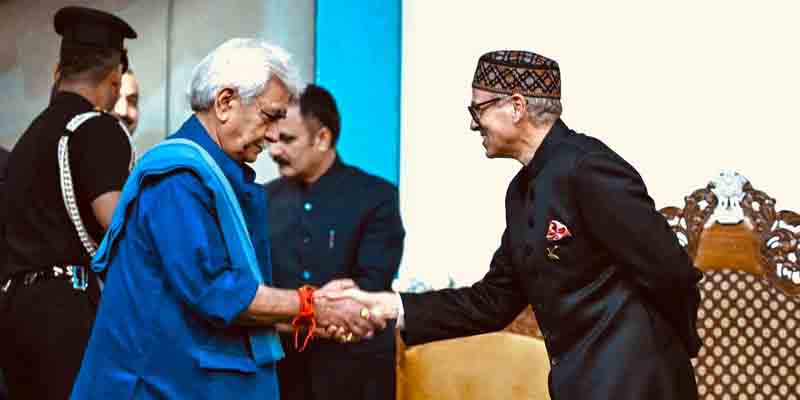
• Jammu & Kashmir Lieutenant Governor Manoj Sinha has cleared a resolution passed by Chief Minister Omar Abdullah-led cabinet urging the Centre to restore the statehood to the Union Territory.
• The erstwhile state was bifurcated into two Union Territories — Jammu & Kashmir and Ladakh — following the revocation of special status under Article 370 in August 2019.
• The Parliament passed the Jammu & Kashmir Reorganisation Bill on August 5, 2019 that led to bifurcation of the erstwhile state.
Article 3 and reorganisation of states
• Article 3 of the Constitution: Formation of new States and alteration of areas, boundaries or names of existing States Parliament may by law:
i) Form a new state by separation of territory from any state or by uniting two or more states or parts of states or by uniting any territory to a part of any state.
ii) Increase the area of any state.
iii) Diminish the area of any state.
iv) Alter the boundaries of any state.
v) Alter the name of any state.
A Bill under Article 3 must satisfy two conditions:
i) It shall be introduced in either House of Parliament only on the recommendation of the President.
ii) If the proposal contained in the Bill affects the area, boundaries or name of any of the States, the Bill has to be referred by the President to the Legislature of the State for expressing its views thereon.
• The President shall specify the period within which the state legislature must express its views.
• If the views of the state legislature are not received within the specified or extended period, the second condition stands fulfilled.
• The President (or Parliament) is not bound by the views of the state legislature and may either accept or reject them, even if the views are received in time. Further, it is not necessary to make a fresh reference to the state legislature every time an amendment to the bill is moved and accepted in Parliament.
Other important points on Article 3
• Article 3 empowers the Parliament to alter the territory or integrity of the states without their consent or concurrence, which differentiates the Indian federal system with that of the traditional system.
• The laws enacted under Article 3 of the Indian Constitution are not considered amendments to the Constitution, even if they modify provisions of the First Schedule (which lists the states and Union Territories) or the Fourth Schedule (which allocates seats in the Rajya Sabha).
(The author is a trainer for Civil Services aspirants.)