
- India
- Feb 08
Use of AI in agriculture
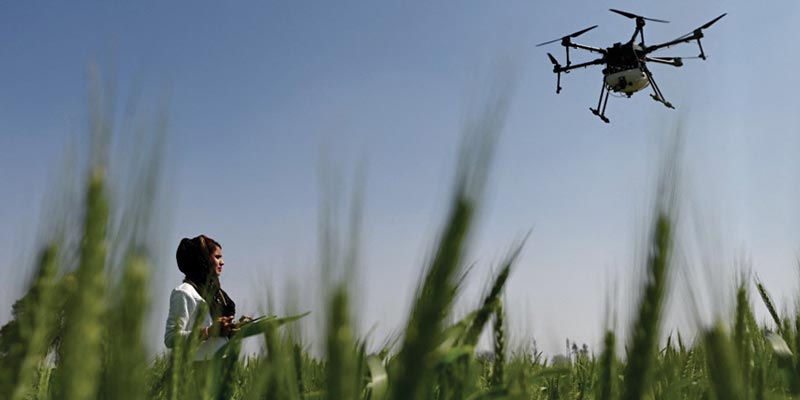
• Farming communities and others involved in agriculture have to adapt agriculture to climate change and other challenges.
• In this context, Information and Communication Technology (ICT)-driven tools and technologies to enhance decision making through accurate, reliable and timely information have an important role to play.
• Agriculture has to look towards emerging technologies for solutions to overcome some of the challenges facing it.
• According to a report, artificial intelligence in agriculture market size is projected to grow from $1.7 billion in 2023 to $4.7 billion by 2028.
• Globally, systems for crop and soil monitoring are leveraging machine learning, remote sensing, satellite imagery, drones, and precision technologies for informed production and management.
• Autonomous robots are being developed to perform previously labour-intensive tasks like harvesting crops in greater volumes and faster than traditional human labourers.
• Nano-based sensing mechanisms and smart sensors are being developed and evaluated for accurate, reliable and cost-effective early and rapid detection of pathogens, allergens, chemicals and contaminants in foods, plant and animal production systems, water and soil.
Use of AI to tackle problems in agriculture in India
• By using modern technologies and AI and giving accurate and timely information regarding crops, weather and insects, etc to farmers may improve the crop productivity, reduce the risk and improve the income of the farmers.
• Some of the applications of AI and Internet of Things (IoT) in agriculture are in the areas of precision farming, agricultural drones and hopping systems, livestock monitoring, monitoring climate conditions, smart greenhouses, computer imaging, etc.
• The Ministry of Agriculture & Farmers Welfare in India has employed AI methods to address various challenges in the agricultural sector to aid farmers.
Some of the initiatives are:
i) ‘Kisan e-Mitra’ an AI-powered chatbot to assist farmers with queries about the PM Kisan Samman Nidhi scheme. This solution supports multiple languages and is evolving to assist with other government programmes.
ii) National Pest Surveillance System for tackling the loss of produce due to climate change. This system utilises AI and machine learning to detect crop issues, enabling timely intervention for healthier crops.
iii) AI based analytics using field photographs for crop health assessment and crop health monitoring using satellite, weather & soil moisture datasets for rice and wheat crops.
• Technologies like drone analytics, automated irrigation, and AI-driven crop disease detection may play a key role in helping farmers to increase productivity.
• The use of unmanned aerial vehicles (UAVs), also known as drones, and connected analytics has great potential to support and address some of the most pressing problems faced by agriculture in terms of access to actionable real-time quality data.
• Drones are remote controlled aircraft with no human pilot on-board. These have a huge potential in agriculture in supporting evidence-based planning and in spatial data collection. Despite some inherent limitations, these tools and technologies can provide valuable data that can then be used to influence policies and decisions.
Additional Read:
India needs to re-imagine the contours of agri sector for next generation
Indian agriculture requires a serious structural transformation because climate change and water criticality loom large in the times to come. Agriculture has a much higher multiplier effect on overall GDP than indicated by its direct contribution. It is important to recognise that India has a good scope to enhance value addition in agriculture and make employment in agri-value chains both remunerative and attractive among Indian youth.
Manorama Yearbook app is now available on Google Play Store and iOS App Store