
- India
- Jul 08
- Sreesha V.M
Scientists discover tiny, plasma loops in Sun’s atmosphere
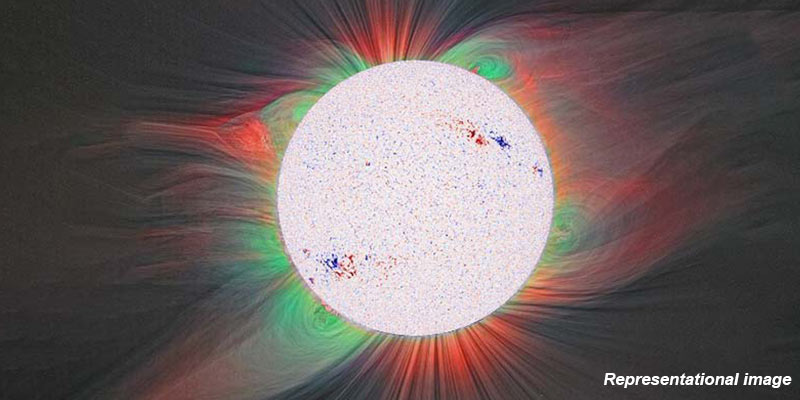
• A team of astronomers has uncovered a phenomenon in the Sun’s atmosphere — tiny, short-lived plasma loops that may hold the key to understanding how our star stores and explosively releases magnetic energy.
• These miniature loops, measuring just 3,000-4,000 kilometres in length (comparable to the distance from Kashmir to Kanyakumari) and less than 100 kilometres in width, have remained hidden until now due to their small size and fleeting existence.
• While the Sun’s large coronal loops — arc-like beautiful structures of hot plasma that glow at a temperature over a million degrees — have long been studied, scientists are now also paying attention to miniature counterparts of these loops.
• These tiny loops, located in the lower layers of the Sun’s atmosphere, last only a few minutes, making them exceptionally difficult to observe.
• However, using high-resolution imaging and spectroscopy from advanced telescopes, researchers from the Indian Institute of Astrophysics (IIA) and their international collaborators have captured these elusive structures in unprecedented detail.
• The team combined data from the Goode Solar Telescope (BBSO), NASA’s Interface Region Imaging Spectrograph (IRIS), and the Solar Dynamics Observatory (SDO) to study these loops across different wavelengths.
• By analysing visible, ultraviolet, and extreme-ultraviolet light, they traced the loops’ behaviour across the chromosphere, transition region, and corona — the Sun’s layered atmosphere.
• The researchers detected spectral line broadening and intensified signals in the H-alpha line, a key indicator of hydrogen activity in the chromosphere.
• These observations suggest the presence of magnetic reconnection, a process where tangled magnetic field lines snap and realign, releasing bursts of energy.
• Using Differential Emission Measure analysis, the team found that the plasma inside these loops reaches temperatures of several million degrees — hot enough to emit extreme ultraviolet light.
• This is puzzling because the loops reside in the chromosphere, where plasma densities are much higher than in the corona, making such extreme heating unexpected.
• The team also observed plasma jets erupting from the tops of these loops, suggesting they share the same explosive origin as larger solar jets. These jets may be driven by the eruption of nearly invisible mini-filaments, further linking these small-scale phenomena to larger solar eruptions.
• The upcoming National Large Solar Telescope (NLST), planned near Pangong Lake in Ladakh, could provide even sharper observations of these loops. With its 2-meter aperture, NLST will enhance our ability to study the Sun’s magnetic activity in finer detail, potentially unlocking more secrets of solar dynamics.
• The findings open a new window into understanding the Sun’s explosive behaviour, offering insights that could improve space weather forecasting and our knowledge of stellar magnetism.
(The author is a trainer for Civil Services aspirants.)