
- India
- Nov 08
- Sreesha V.M
Kochi hosts first BIMReN biennial conference
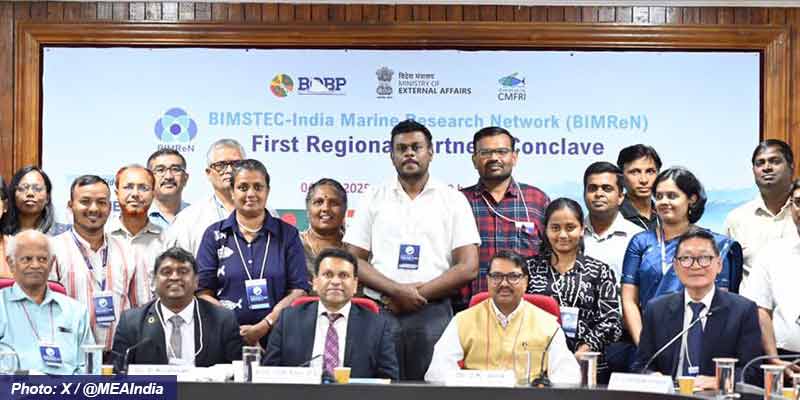
• The first biennial conference of BIMSTEC-India Marine Research Network (BIMReN) was hosted in Kochi from November 4 to 6.
• BIMReN is an initiative of the Ministry of External Affairs.
• The BIMReN initiative was announced by Prime Minister Narendra Modi during the Colombo BIMSTEC Summit in 2022, to strengthen collective research in marine sciences.
• It was launched in 2024.
• It enables institutional collaborations, through twinning research grants and split-site PhD fellowships, linking leading Indian research institutions with those in other BIMSTEC countries.
• It aligns with India’s broader regional policy objectives under its Neighbourhood First, Act East, Indo-Pacific and MAHASAGAR strategies.
• The launch of BIMReN by India is testimony to its long-term commitment towards sustainable fisheries management through regional cooperation in the Bay of Bengal, which accounts for 6 per cent of the world’s fish catch and over a third of world’s fishing fleet ply around it.
• The pilot phase of BIMReN has till date connected 25 institutions and over 50 researchers from BIMSTEC countries.
• The first biennial conference of BIMReN in Kochi brought together partners to engage in discussions and exchange of views on the outcomes of activities since its launch.
• The event served as a milestone in advancing regional cooperation in marine research and sustainable blue economy initiatives focused on marine challenges, ecosystem health, and research innovations, including building scientific networks among young researchers, effective marine resource management and harmonious policy development.
What is BIMSTEC?
• The Bay of Bengal Initiative for Multi-Sectoral Technical and Economic Cooperation (BIMSTEC) comprises India, Bangladesh, Myanmar, Sri Lanka, Thailand, Bhutan and Nepal.
• It is a regional bloc comprising seven countries lying in the littoral and adjacent areas of the Bay of Bengal constituting a contiguous regional unity.
• This sub-regional organisation came into being on June 6, 1997 through the Bangkok Declaration. It constitutes five countries from South Asia (Bangladesh, Bhutan, India, Nepal and Sri Lanka) and two from Southeast Asia (Myanmar and Thailand).
• Initially, the economic bloc was formed with four member states with the acronym BIST-EC (Bangladesh, India, Sri Lanka and Thailand Economic Cooperation). Following the inclusion of Myanmar on December 22, 1997 during a special ministerial meeting in Bangkok, the group was renamed BIMSTEC (Bangladesh, India, Myanmar, Sri Lanka and Thailand Economic Cooperation).
• With the admission of Nepal and Bhutan at the sixth ministerial meeting in February 2004, the name of the grouping was changed to Bay of Bengal Initiative for Multi-Sectoral Technical and Economic Cooperation (BIMSTEC).
• The BIMSTEC region is home to about 1.8 billion people, accounting for about 22 per cent of the global population with a combined GDP of $4.5 trillion.
• The BIMSTEC Secretariat is situated in Dhaka.
• India has been pushing for making BIMSTEC a vibrant forum as various regional initiatives under South Asian Association for Regional Cooperation (SAARC) were not moving forward primarily due to non-cooperation from Pakistan.
• For India, BIMSTEC is a natural choice to take forward key foreign policy priorities like ‘Neighbourhood First’ and ‘Act East’ as the bloc enjoys the strength of connecting South and Southeast Asia.
• Initially, six sectors — trade, technology, energy, transport, tourism and fisheries — were included for sectoral cooperation. It was later expanded to 14 areas of cooperation.
(The author is a trainer for Civil Services aspirants.)