
- India
- Nov 20
ISRO completes key restart test on CE20 cryogenic engine
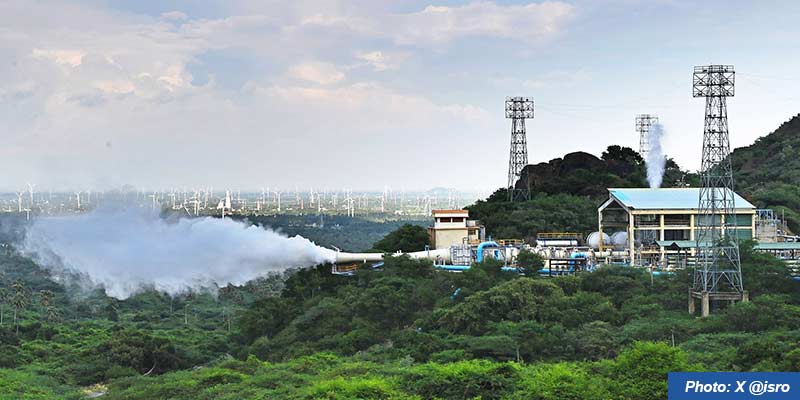
• The Indian Space Research Organisation (ISRO) announced that it has successfully demonstrated the boot-strap mode start test of the CE20 cryogenic engine, which powers the upper stage of the Launch Vehicle Mark-3 (LVM3) rocket.
• The test was conducted for 10 seconds under vacuum conditions at the High-Altitude Test (HAT) facility at ISRO Propulsion Complex, Mahendragiri.
• The CE20 cryogenic engine is already qualified for operation at thrust levels between 19 and 22 tonnes with a single start in flight and is cleared for use in the Gaganyaan missions.
Significance of this test
• Under normal conditions, the engine ignition begins under tank head pressure, followed by a turbopump start-up using a stored gas start-up system.
• For future missions, multiple in-flight restarts of the CE20 engine will be required for mission flexibility, towards multi-orbit missions.
• With the current configuration, each restart requires an additional start-up gas bottle and associated systems, leading to a reduction in vehicle payload capability.
• Hence, achieving boot-strap mode start — where the engine builds up to steady operation without external start-up assistance — is essential.
• During the test, a multi-element igniter was employed in both the thrust chamber and gas generator to facilitate boot-strap starting.
• In this test, following the ignition of the thrust chamber, the gas generator was ignited under tank head conditions, and the turbopumps were started without the use of the start-up system.
• Subsequently, boot-strap mode build-up and steady-state operation of the engine were successfully demonstrated.
• With this achievement, ISRO has successfully demonstrated boot-strap mode starting of a gas-generator cycle cryogenic engine without any auxiliary start-up system.
• It is a significant milestone towards enhancing the restart capability and mission flexibility of future LVM3 flights.