
- India
- Nov 26
Explainer - Constitution Day
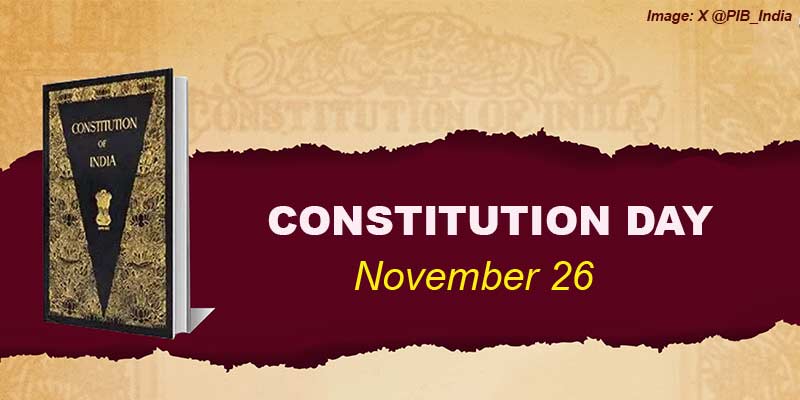
• Since 2015, Constitution Day or Samvidhan Diwas is celebrated on November 26 to commemorate the adoption of the Constitution by the Constituent Assembly on November 26, 1949.
• On November 26, 1949, the Constituent Assembly of India adopted the Constitution of India, which came into effect from January 26, 1950 when India became a republic.
• President Droupadi Murmu led the celebrations to mark Constitution Day at the Central Hall of the Old Parliament building, now called ‘Samvidhan Sadan’.
• As part of the event, the Constitution was launched digitally in nine languages — Malayalam, Marathi, Nepali, Punjabi, Bodo, Kashmiri, Telugu, Odia and Assamese — prepared by the legislative department of the Union Law Ministry.
• A commemorative booklet on calligraphy in the original Constitution was also released.
Framing of the Constitution
• Early Proposal: The idea of a Constituent Assembly was first proposed by M.N. Roy in 1934.
• Formation of the Constituent Assembly: Elections for the formation of the Constituent Assembly were held under the Cabinet Mission Plan in 1946.
• The Constituent Assembly met for the first time in New Delhi on December 9, 1946 in the Central Hall of the old Parliament House building.
• The Constituent Assembly took almost three years (two years, eleven months and 17 days to be precise) to complete its historic task of drafting the Constitution for Independent India. During this period, it held 11 sessions covering a total of 165 days. Of these, 114 days were spent on the consideration of the Draft Constitution.
• Committees Involved in Framing the Constitution: The Constituent Assembly of India appointed 13 committees to handle different tasks related to framing the Constitution. Out of these, 8 were major committees:
i) Drafting Committee: Chaired by Dr. B. R. Ambedkar.
ii) Union Power Committee: Chaired by Jawaharlal Nehru.
iii) Union Constitution Committee: Chaired by Jawaharlal Nehru.
iv) Provincial Constitution Committee: Chaired by Vallabhbhai Patel.
v) Advisory Committee on Fundamental Rights, Minorities, and Tribal and Excluded Areas: Chaired by Sardar Vallabhbhai Patel.
vi) Rules of Procedure Committee: Chaired by Rajendra Prasad.
vii) States Committee (Committee for Negotiating with States): Chaired by Jawaharlal Nehru.
viii) Steering Committee: Chaired by Rajendra Prasad.
• The Constitution was adopted in 1949 when 284 members signed it, marking the completion of the Constitution making process.
The need for Constitution in a democracy
• In a democracy, the Constitution is a sacred text for the government. It lays a strong foundation for a parliamentary democracy to function.
• The Constitution is the supreme law of a nation.
• India is the largest democracy in the world, and its Constitution serves as a guiding light for it to function smoothly and vibrantly.
• The Constitution of India is the foundational law laying down the basic political structure of India — a Parliamentary Democracy and a Republic with a Federal Structure.
• It defines the three organs of the Republic of India – the Executive, the Legislature and the Judiciary and clearly defines their power as well as demarcates their responsibilities.
The Executive:
• The President of India
• The Vice President of India
• Council of Ministers.
The Legislature:
• The President of India
• Rajya Sabha (The Council of States)
• Lok Sabha (The House of the People).
The Judiciary:
• The Supreme Court
• The High Courts
• The Subordinate Courts.
What is the Preamble?
• A brief introductory statement setting out guidelines for the people of the nation as well as presenting principles of the Constitution.
• Preamble is the preface which highlights the entire Constitution and embodies fundamental values, philosophy & ethos on which our Constitution is based and built.
• It includes Fundamental Rights (Liberty of thought, expression, belief, faith & worship) and Fundamental Duties (Justice, social, economic & political).
• The whole edifice of the Constitution and structure of the political system protect and promote constitutional values embodied in the Preamble.
Key facts about Constitution of India:
• Length: It is the world’s longest written Constitution. The original copy of the Indian Constitution is 251 pages long. It is the most detailed in the world. The original text of the Constitution contained 395 articles in 22 Parts and eight Schedules. Currently, there are 448 articles in 25 Parts, 12 Schedules with more than 100 amendments.
• Government Structure: The Constitution establishes a Federal System with Unitary Features and follows a Parliamentary Form of Government.
• Original Copies: The original copies of the Constitution were handwritten, not typed or printed. They are now preserved in helium-filled cases in the library of the Parliament.
• Handwritten by Prem Bihari Narain Raizada: The unique copies of the Constitution were written by Prem Bihari Narain Raizada.
• Languages: Initially, the Constitution was written in English and Hindi. The basic structure of the Indian Constitution draws heavily from the Government of India Act, 1935.