
- India
- Nov 28
IMD issues alert on Cyclone ‘Ditwah’
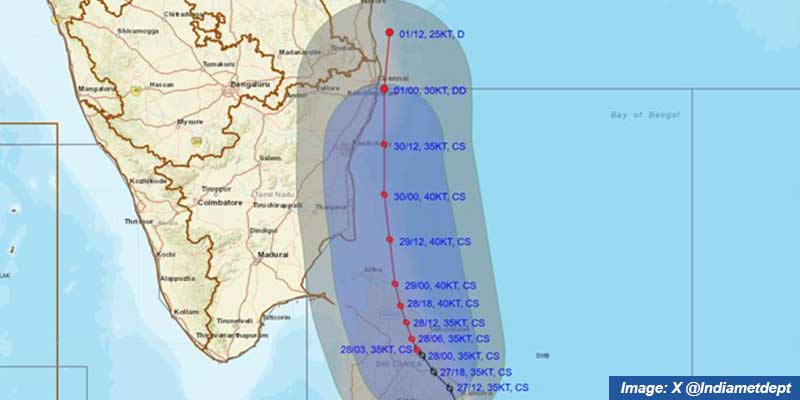
• The Indian Meteorological Department (IMD) has warned that Cyclone ‘Ditwah’, formed in the Bay of Bengal and is heading towards Tamil Nadu, coastal Andhra Pradesh, and Puducherry.
• The IMD said that it is likely to approach Chennai on November 30.
• Strong winds, heavy rain and dangerous sea conditions are expected over the next few days.
• The name ‘Ditwah’ was suggested by Yemen as part of the cyclone naming convention. It is likely named after Detwah Lagoon, a large, saline lagoon on the northwest coast of the island of Socotra in Yemen.
What is the difference between a typhoon, hurricane and cyclone?
• The terms hurricane and typhoon are regional names for tropical cyclones.
• All tropical cyclones are alike in that they draw heat from warm water at the ocean’s surface to power horizontal, rotating wind.
• Although similar in size, tropical cyclones have a different energy source than synoptic cyclones, which are storm systems that draw their energy from weather fronts and jet streams.
• In the North Atlantic, central North Pacific, and eastern North Pacific, the term hurricane is used.
• The same type of disturbance in the Northwest Pacific is called a typhoon.
• Meanwhile, in the South Pacific and Indian Ocean, the generic term tropical cyclone is used.
• The ingredients for tropical cyclones include a pre-existing weather disturbance, warm tropical oceans, moisture, and relatively light winds. If the right conditions persist long enough, they can combine to produce the violent winds, large waves, torrential rains, and floods we associate with this phenomenon.
Naming of tropical cyclones
• Tropical cyclones are named to provide easy communication between forecasters and the public regarding forecasts, watches and warnings. Since the storms can often last a week or longer and that more than one can be occurring in the same basin at the same time, names can reduce the confusion about what storm is being described.
• In general, tropical cyclones are named according to the rules at regional level. In the Atlantic and in the Southern hemisphere (Indian ocean and South Pacific), tropical cyclones receive names in alphabetical order, and women and men’s names are alternated.
• In the beginning, storms were named arbitrarily. An Atlantic storm that ripped off the mast of a boat named Antje became known as Antje’s hurricane. Then the mid-1900s saw the start of the practice of using feminine names for storms.
• In the pursuit of a more organised and efficient naming system, meteorologists later decided to identify storms using names from a list arranged alphabetically. Thus, a storm with a name which begins with A, like Anne, would be the first storm to occur in the year. Before the end of the 1900s, forecasters started using male names for those forming in the Southern Hemisphere.
• Since 1953, Atlantic tropical storms have been named from lists originated by the National Hurricane Center. They are now maintained and updated by an international committee of the World Meteorological Organisation (WMO). The original name lists featured only women’s names. In 1979, men’s names were introduced and they alternate with the women’s names. Six lists are used in rotation. Thus, the 2019 list will be used again in 2025.
• Short and easy-to-pronounce names are helpful in rapidly and effectively disseminating detailed storm information between hundreds of scattered stations, coastal bases and ships at sea.
• It is less subject to error than the older and more cumbersome latitude-longitude identification methods.
• There are six Regional Specialised Meteorological Centres (RSMCs) worldwide and five regional Tropical Cyclone Warning Centres, which are mandated for issuing advisories and naming of cyclonic storms.
• The India Meteorological Department (IMD) is one of the RSMCs and is tasked with giving a title to a cyclone that forms over the northern Indian Ocean when they have reached a maximum sustained surface wind speed of 62 kmph or more.
• The IMD provides cyclone and storm surge advisories to 13 countries across the north Indian Ocean.
• For cyclones in the Bay of Bengal and Arabian Sea, a naming system was agreed by countries of a group called World Meteorological Organisation/Economic and Social Commission for Asia and the Pacific (WMO/ESCAP) and took effect in 2004.
• The eight countries along the Bay of Bengal and Arabian Sea — Bangladesh, India, Maldives, Myanmar, Oman, Pakistan, Sri Lanka and Thailand — suggested names that were sequentially listed.
• The list is arranged according to the names, given by alphabetically-arranged counties, that are neutral to gender, politics, religious beliefs and cultures. It is used sequentially, column wise.
• The designation should not be present in the existing list of the six RSMCs. The name of a storm from the South China Sea that crosses Thailand and emerges into the Bay of Bengal will not be changed.
• Once a name is used, it will not be repeated again. The word, which can have a maximum of eight letters, should not be offensive to any member country or hurt the sentiments of any group of population.
• In 2020, a new list was released with 169 names, including 13 names each from 13 countries. Earlier, eight countries had given 64 designations.