
- India
- Dec 02
50th anniversary of Biological Weapons Convention
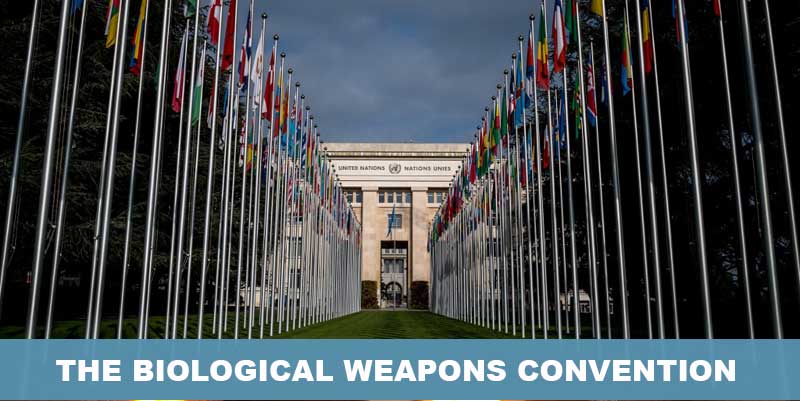
• India is one of the 189 States Parties to the Biological Weapons Convention (BWC).
• The Ministry of External Affairs is conducting an international conference on ‘50 Years of BWC: Strengthening Biosecurity for the Global South’ in New Delhi on December 1 & 2 to commemorate the 50th anniversary of the entry into force of the BWC.
• Minister of External Affairs S. Jaishankar reaffirmed India’s commitment to the full and effective implementation of the Biological Weapons Convention and India’s well-established non-proliferation record.
What are biological weapons?
• Biological weapons disseminate disease-causing organisms or toxins to harm or kill humans, animals or plants.
• They generally consist of two parts — a weaponised agent and a delivery mechanism.
• Almost any disease-causing organism (such as bacteria, viruses, fungi, prions or rickettsiae) or toxin (poisons derived from animals, plants or microorganisms, or similar substances produced synthetically) can be used in biological weapons. The agents can be enhanced from their natural state to make them more suitable for mass production, storage, and dissemination as weapons.
• Biological weapons delivery systems can take a variety of forms. Past programmes have constructed missiles, bombs, hand grenades and rockets to deliver biological weapons. A number of programmes also designed spray-tanks to be fitted to aircraft, cars, trucks and boats.
• In addition to strategic or tactical military applications, biological weapons can be used for political assassinations, the infection of livestock or agricultural produce to cause food shortages and economic loss, the creation of environmental catastrophes, and the introduction of widespread illness, fear and mistrust among the public.
Biological Weapons Convention (BWC)
• The Biological Weapons Convention (BWC) effectively prohibits the development, production, acquisition, transfer, stockpiling and use of biological and toxin weapons.
• It was the first multilateral disarmament treaty banning an entire category of weapons of mass destruction (WMD).
• The BWC is a key element in the international community’s efforts to address WMD proliferation and it has established a strong norm against biological weapons. The Convention has reached almost universal membership with 188 States Parties and four Signatory States.
• Formally known as ‘The Convention on the Prohibition of the Development, Production and Stockpiling of Bacteriological (Biological) and Toxin Weapons and on their Destruction’, the Convention was negotiated by the Conference of the Committee on Disarmament in Geneva, Switzerland.
• It opened for signature on April 10, 1972 and entered into force on March 26, 1975.
• The BWC supplements the 1925 Geneva Protocol (formally known as the Protocol for the Prohibition of the Use in War of Asphyxiating, Poisonous or other Gases, and of Bacteriological Methods of Warfare).
• Today, 189 countries are party to the Convention, which effectively prohibits the development, production, acquisition, transfer, stockpiling and use of biological and toxin weapons.
• The BWC stands as a safeguard, ensuring that advances in biology and biotechnology are used solely for “peaceful purposes” — and not to trigger artificial epidemics that threaten us all.
• The United Nations Office for Disarmament Affairs (UNODA) is working to support the Convention’s implementation.