
- India
- Dec 02
NCPOR celebrates Antarctica Day
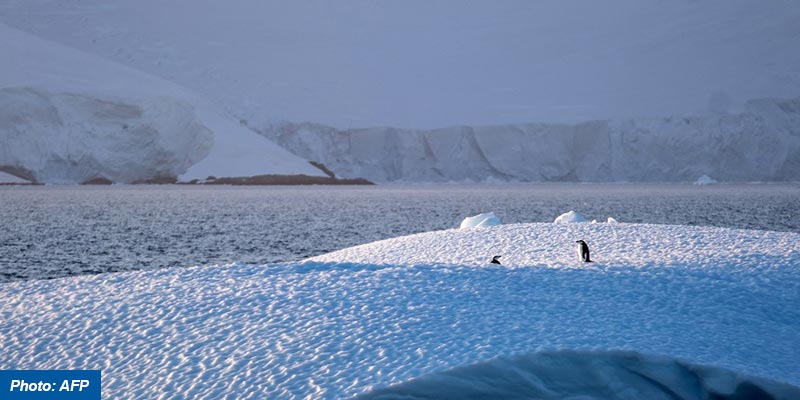
• The National Centre for Polar and Ocean Research (NCPOR) celebrated Antarctica Day at its campus at Vasco da Gama, Goa on December 1.
• Antarctica Day is celebrated worldwide to commemorate the signing of the Antarctic Treaty on December 1, 1959.
• The treaty designates Antarctica as a continent exclusively reserved for peace and scientific research.
• Goa Governor Pusapati Ashok Gajapathi Raju released a special commemorative postage stamp marking the silver jubilee of the establishment of the NCPOR.
• The release of the commemorative stamp stands as a significant acknowledgment of NCPOR's remarkable contributions and 25 glorious years of dedicated service to the nation in polar and ocean research since its inception on April 5, 2000.
What is NCPOR?
• NCPOR is an autonomous body under the Ministry of Earth Sciences.
• It was created to manage national expeditions and strategic interests in polar regions.
• Over the last two decades, NCPOR has made significant strides in research and infrastructure development in the polar regions.
• The institute leads the strategically important Deep Ocean Mission project.
• NCPOR operates two remote stations in Antarctica — Maitri and Bharati, one in the Arctic — Himadri, and one in the Himalayas — Himansh.
• It also manages a floating oceanographic platform called Sagar Kanya.
• The institute spearheads several geoscientific programs of great national significance.
What is the Antarctic Treaty?
• The Antarctic Treaty was signed in Washington on December 1, 1959 by the 12 countries whose scientists had been active in and around Antarctica during the International Geophysical Year (IGY) of 1957-58.
• It entered into force in 1961 and has since been acceded to by many other nations. The total number of Parties to the Treaty is now 58.
• India signed the Antarctic Treaty on August 19, 1983.
• These nations represent a diverse array of countries from all over the world, highlighting the global commitment to upholding the principles outlined in this historic agreement.
• They are entitled to participate in the Consultative Meetings during such times as they demonstrate their interest in Antarctica by “conducting substantial research activity there” .
• The Antarctic Treaty consists of 14 articles that establish a framework for the governance of Antarctica.
• The Antarctic Treaty provides that “Antarctica shall be used for peaceful purposes only”. To this end it prohibits “any measures of a military nature” but does “not prevent the use of military personnel or equipment for scientific research or for any other peaceful purpose”.
• The Secretariat of the Antarctic Treaty is located in downtown Buenos Aires, Argentina. The Secretariat and its work are funded by the Consultative Parties.
• The Protocol on Environmental Protection to the Antarctic Treaty was signed in Madrid in 1991 and entered into force in 1998, to strengthen the Antarctic Treaty system and for the development of a comprehensive regime for the protection of the Antarctic environment and dependent and associated ecosystems.
• India ratified the Madrid Protocol on January 14, 1998.
• It designates Antarctica as a “natural reserve, devoted to peace and science”. Until 2048, the Protocol can only be modified by unanimous agreement of all Consultative Parties to the Antarctic Treaty.
India’s research base stations in Antarctica
• Since 1981, India has completed 40 scientific expeditions and built three permanent research base stations in Antarctica — Dakshin Gangotri (1983), Maitri (1988) and Bharati (2012).
• Dakshin Gangotri was established in 1983 over the Ice Shelf in the Central Dronning Maud Land region. The station was abandoned in 1990 as it got buried under snow.
• Currently, Maitri and Bharati are fully operational.
• Maitri has been operational since 1989 in the central part of Schirmacher Oasis, in Central Dronning Maudland region of East Antarctica. The Maitri station is functional round the year. It serves as a gateway to one of the largest mountain chains in central Dronning Maud land, located south of Schirmacher. It is an inland station about 100 km from the shore at an elevation of about 50 meters above sea level. It can support 25 persons in the main building during summer as well as winter and about 40 in the summer facility consisting of containerised living modules.
• Bharati is located between Thala Fjord & Quilty bay, east of Stornes Peninsula in Antarctica. The station was commissioned on March 18, 2012 to facilitate year-round scientific research activity by the Indian Antarctic programme.