
- India
- Dec 03
President Murmu pays tribute to Rajendra Prasad on his birth anniversary
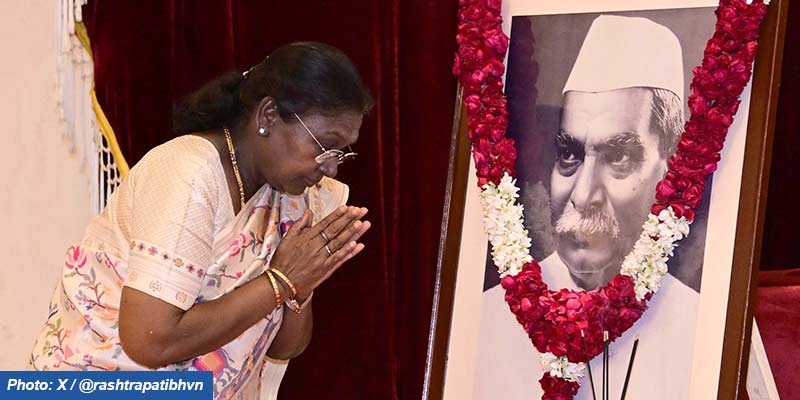
President Droupadi Murmu paid floral tributes to Dr. Rajendra Prasad, the first President of India, on his birth anniversary at Rashtrapati Bhavan on December 3.
A key figure in the Indian freedom struggle
• One of the chief architects of modern India, Dr. Rajendra Prasad was an eminent freedom fighter, renowned jurist, an eloquent parliamentarian, and a statesman.
• Rajendra Prasad was born at Ziradei village in Saran district (now in Siwan) of Bihar on December 3, 1884.
• After his post-graduation, he also completed his studies in law and started legal practice in Calcutta in 1911.
• He completed his Master of Law in 1915 by topping the list. In 1916, after the creation of the Patna High Court, Rajendra Prasad started practising at Patna.
• Prasad came under the spell of Mahatma Gandhi in 1917 when the latter organised the Champaran Satyagraha to liberate the peasants from exploitation by the British Indigo planters. Gandhiji invited Rajendra Prasad and some other advocates to assist him in the cause of the affected peasants.
• Inspired by Gandhian ideology, his clarion call to the countrymen and his distinct and unprecedented mode of protest against the colonial rulers, Rajendra Prasad took the plunge into the political struggle with the unflinching aim of freeing the country from the clutches of colonialism.
• He was the first leader from Bihar to sign and undertake a pledge requiring every Satyagrahi to remain non-violent during the protest against the Rowlatt Act which came to be dubbed as the ‘Black Act’.
• Joining the Indian National Congress as an ordinary worker, Rajendra Prasad served the organisation in various capacities for more than four decades.
• The British government arrested him for taking part in the 1930 Salt Satyagraha. The second long spell of imprisonment that Rajendra Prasad suffered was immediately after the passing of the Quit India Resolution in 1942 and he remained in jail for nearly three years till 1945.
• He was elected president of the Indian National Congress in 1935 and again in 1939 following the resignation of Netaji Subhas Chandra Bose.
• He was elected president of the Congress for the third time in 1947, following the resignation of Acharya J.B. Kripalani.
• In 1946, Rajendra Prasad joined the Interim Government of Pandit Jawaharlal Nehru as the Minister of Food and Agriculture.
• When the Constituent Assembly was formed in 1946 to frame a Constitution for free India, Rajendra Prasad, who had been elected as a member of the Assembly from the Bihar Province, was given the onerous responsibility of being its president.
• Rajendra Prasad was unanimously elected as the provisional President of India on January 24, 1950, the penultimate day of the last session of the Constituent Assembly. He took the oath of office on January 26, 1950.
• He served two terms as President (from January 26, 1950 to May 13, 1962) and then retired from active politics, spending the rest of his life at the Sadaqat Ashram in Patna, Bihar.
• He wrote a number of books in English and Hindi, apart from editing a few newspapers.
• In the early 1920s, he took up the editing of a Hindi weekly ‘Desh’ and an English biweekly, ‘Searchlight’.
• He also authored several books including ‘India Divided’, ‘Rajendra Prasad’ (autobiography) and ‘At the Feet of Mahatma Gandhi’.
• He passed away on February 28, 1963.