
- India
- Dec 06
- Sreesha V.M
Key outcomes of Putin’s visit to India
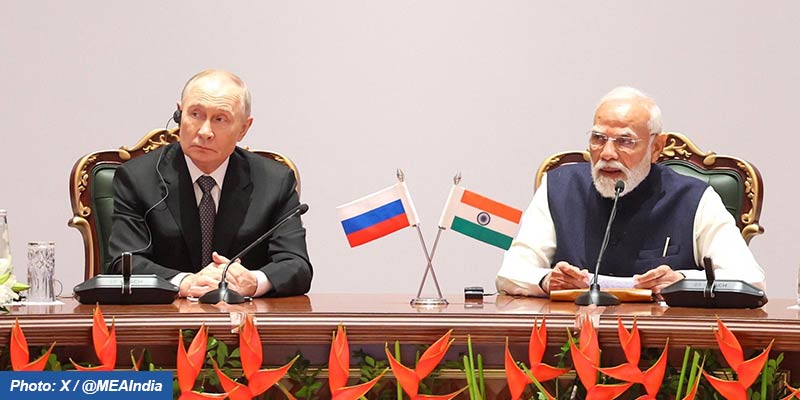
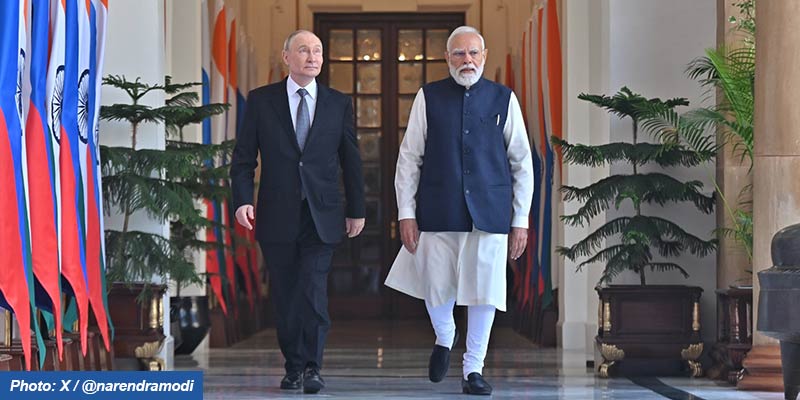
• Russian President Vladimir Putin paid a State visit to India on December 4 & 5 for the 23rd India-Russia Annual Summit.
• During the Summit, Prime Minister Narendra Modi and Putin reaffirmed their support for further strengthening of the Special and Privileged Strategic Partnership between India and Russia.
• The leaders positively assessed the multi-faceted mutually beneficial India-Russia relations that span all areas of cooperation, including political and strategic, military and security, trade and investment, energy, science and technology, nuclear, space, cultural, education and humanitarian cooperation.
• Both sides emphasised that addressing tariff and non-tariff trade barriers, removing bottlenecks in logistics, promoting connectivity, ensuring smooth payment mechanisms, finding mutually acceptable solutions for issues of insurance and reinsurance and regular interaction between the businesses of the two countries are among the key elements for timely achievement of the revised bilateral trade target of $100 billion by 2030.
• The two sides discussed cooperation in the civil nuclear energy domain in the context of ramping up generation of clean energy.
• They confirmed their intention to broaden cooperation in nuclear energy, including fuel cycle, life cycle support for operating Kudankulam Nuclear Power Plant (KNPP) and non-power applications.
Key outcomes of the Summit:
1) Migration and mobility
i) Agreement on Temporary Labour Activity of Citizens of one State in the Territory of the other State.
ii) Agreement on cooperation in combating irregular migration.
• These agreements establish a framework for the movement of skilled workers from India to Russia and aims to promote safe and mutually beneficial migration between the two countries.
2) Health and food safety
i) Agreement on the cooperation in the field of healthcare, medical education and science.
• It envisages cooperation between India and Russia in the field of healthcare, medical education and science through exchange of information and specialists, and joint scientific research.
ii) Agreement on consumer rights protection and human well-being in the field of food safety.
• It aims to develop cooperation in the field of food safety by ensuring quality and compliance with sanitary and hygienic requirements of food products.
3) Maritime cooperation and polar waters
i) MoU on training of specialists for ships operating in polar waters.
• It seeks to facilitate training of Indian sea farers in polar waters through programmes designed and facilitated by Russian agencies specialising in this field.
ii) MoU for cooperation in various sectors of maritime domain such as shipping, ports, joint mineral exploration, research and development.
4) Customs and commerce
i) Protocol for cooperation in exchange of pre-arrival information in respect of goods and vehicles moved between the two countries.
• It provides a framework for cooperation between India and Russia in the field of exchange of information of customs operations to optimise procedures of customs control.
ii) A bilateral agreement to strengthen cross-border postal cooperation and support growing e-commerce between India and Russia, especially for Small and Medium Enterprises.
Key announcements:
i) Programme for the Development of Strategic Areas of India-Russia Economic Cooperation till 2030.
ii) The Russian side has decided to adopt the Framework Agreement to join the International Big Cat Alliance (IBCA).
iii) Agreement for the exhibition ‘India - Fabric of Time’ between the National Crafts Museum & Hastkala Academy (New Delhi) and the Tsaritsyno State Historical, Architectural, Art and Landscape Museum-Reserve (Moscow)
iv) Grant of 30 days e-tourist visa on gratis basis to Russian nationals on reciprocal basis
v) Grant of group tourist visa on gratis basis to Russian nationals.
(The author is a trainer for Civil Services aspirants.)