
- India
- Dec 08
- Sreesha V.M
UNESCO’s 20th Intangible Cultural Heritage Session begins in New Delhi
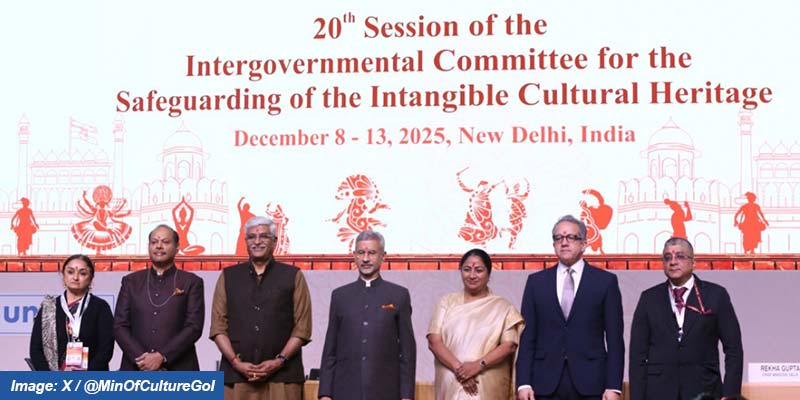
• The 20th session of the Intergovernmental Committee for the Safeguarding of Intangible Cultural Heritage (ICH) began at the Red Fort on December 8. It will conclude on 13.
• This is the first time that India is hosting the ICH Committee session.
• The meeting is chaired by Vishal V. Sharma, India’s permanent delegate to UNESCO.
• The event coincides with the 20th anniversary of India’s ratification of the 2003 Convention for Safeguarding of the Intangible Cultural Heritage in 2005.
• India has served on the UNESCO Intergovernmental Committee for three terms.
• India, as a State Party to the UNESCO 2003 Convention for Safeguarding of the Intangible Cultural Heritage, has actively advanced the preservation of its living cultural traditions through national institutions such as the Ministry of Culture and the Sangeet Natak Akademi.
• To date, 15 Indian elements have been inscribed on UNESCO’s Representative List of the Intangible Cultural Heritage of Humanity.
Intangible cultural heritage
• Intangible cultural heritage, as UNESCO defines it, includes the practices, knowledge, expressions, objects, and spaces that communities see as part of their cultural identity.
• Passed down over generations, this heritage evolves, strengthening cultural identity and appreciation of diversity.
• The term ‘cultural heritage’ has changed content considerably in recent decades, partially owing to the instruments developed by UNESCO.
• Cultural heritage does not end at monuments and collections of objects.
• It also includes traditions or living expressions inherited from our ancestors and passed on to our descendants, such as oral traditions, performing arts, social practices, rituals, festive events, knowledge and practices concerning nature and the universe or the knowledge and skills to produce traditional crafts.
• The importance of intangible cultural heritage is not the cultural manifestation itself but rather the wealth of knowledge and skills that is transmitted through it from one generation to the next.
UNESCO’s 2003 Convention for the Safeguarding of the Intangible Cultural Heritage proposes five broad ‘domains’ in which intangible cultural heritage is manifested:
i) Oral traditions and expressions, including language as a vehicle of the intangible cultural heritage.
ii) Performing arts.
iii) Social practices, rituals and festive events.
iv) Knowledge and practices concerning nature and the universe.
v) Traditional craftsmanship.
The Convention for the Safeguarding of the Intangible Cultural Heritage
• For the Safeguarding of Intangible Cultural Heritage, UNESCO adopted the 2003 Convention in its 32nd General Conference in Paris
• The 2003 Convention for the Safeguarding of the Intangible Cultural Heritage entered into force on April 20, 2006.
• The General Assembly of the States Parties to the Convention is the sovereign body of the Convention.
• The General Assembly meets in ordinary session every two years and may convene extraordinary sessions if it deems it necessary or at the request of either the Committee or of at least one-third of the States Parties.
• The General Assembly gives strategic orientations for the implementation of the Convention and elects the 24 members of the Intergovernmental Committee for the Safeguarding of the Intangible Cultural Heritage.
• Member States to the Committee are elected for a term of four years.
• Half of the Committee members are renewed every two years.
• In order to reflect the diversity of opinions and of safeguarding measures concerning intangible cultural heritage around the world, the General Assembly decided to apply the principle of equitable geographical distribution to the election of Committee members.
• The number of Committee members from each region proportionally depends on the number of States from that region that have already ratified the Convention.
Core functions of the Committee are to:
• Promote the objectives of the Convention, provide guidance on best practices and make recommendations on measures for the safeguarding of the intangible cultural heritage.
• Use the resources of the Intangible Cultural Heritage Fund in accordance with the guidelines and the biannual plan adopted by the General Assembly.
• Inscribe intangible cultural heritage manifestations proposed by States Parties on the Lists of the Convention mentioned in Articles 16 and 17.
• Select and promote programmes, projects and activities submitted by States Parties which best reflect the objectives and principles of the Convention, as mentioned in its Article 18.
• Propose to the General Assembly the accreditation of non-governmental organisations which may have advisory functions to the Committee.
(The author is a trainer for Civil Services aspirants.)