
- India
- Dec 11
India to host 2nd WHO Global Summit on traditional medicine
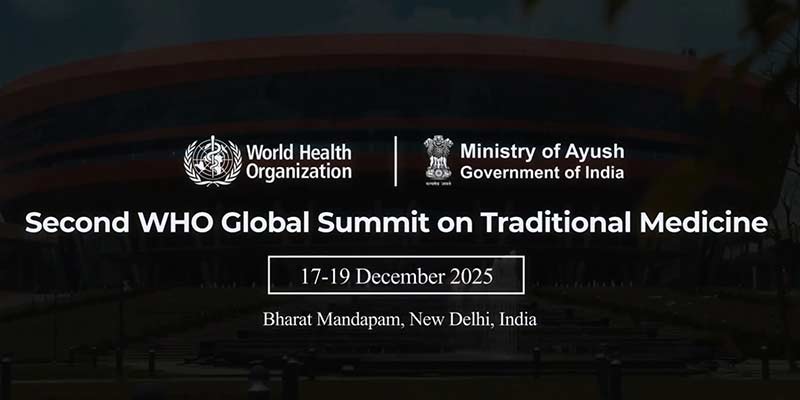
• India will co-host the 2nd WHO Global Summit on Traditional Medicine in New Delhi from December 17 to 19 in collaboration with the World Health Organisation (WHO).
• The Summit will convene global leaders, policymakers, and experts to deliberate on future strategies, innovation, and evidence-based practices in traditional medicine.
• The inaugural WHO Global Summit on Traditional Medicine in 2023 in Gandhinagar laid the groundwork, offering data, technologies and insights to elevate traditional medicine in the global health agenda.
• Building on this success, the 2025 Summit will delve deeper into the scientific innovations shaping the field, addressing critical issues such as biodiversity protection, intellectual property rights and the transformative potential of AI, and will include announcements of new pledges, products and innovations.
• The theme of the Summit is “Restoring balance: The science and practice of health and well-being”.
• It will feature ministerial discussions, scientific panels, exhibitions and global knowledge-sharing sessions aimed at strengthening the integration of traditional medicine within public health systems worldwide.
• The Ministry of AYUSH will host a dedicated side event on Ashwagandha, one of India’s most renowned and scientifically studied medicinal plants, highlighting its importance in traditional and contemporary health practices.
• Simultaneously, WHO is launching a global traditional medicine library — the first-of-its-kind digital platform with over 1.6 million scientific records on the topic, a traditional medicine data network and a Framework on Indigenous Knowledge, Biodiversity and Health, among other initiatives.
Traditional medicine
• Traditional medicine has a long history. It is the sum total of the knowledge, skill, and practices based on the theories, beliefs, and experiences indigenous to different cultures, whether explicable or not, used in the maintenance of health as well as in the prevention, diagnosis, improvement or treatment of physical and mental illness.
• Its reach encompasses ancient practices such as acupuncture, ayurvedic medicine and herbal mixtures as well as modern medicines.
• The terms “complementary medicine” or “alternative medicine” refer to a broad set of health care practices that are not part of that country’s own tradition or conventional medicine and are not fully integrated into the dominant health care system. They are used interchangeably with traditional medicine in some countries.
• Traditional and complementary medicine (T&CM) is an important and often underestimated health resource with many applications, especially in the prevention and management of lifestyle-related chronic diseases, and in meeting the health needs of ageing populations.
• Around 80 per cent of the world’s population is estimated to use traditional medicine. As many as 170 of the 194 WHO Member States have reported the use of traditional medicine
• The global popularity of traditional medicine is on the rise, driven by a growing interest in holistic health approaches that emphasize prevention, promotion and rehabilitation.
Additional Read:
Use of AI in traditional medicine
Cutting-edge computer systems, enhanced with AI and other frontier technologies like machine learning and big data analysis, have the potential to advance personalised medicine by analysing individual health data such as medical records and imaging results and employing predictive analysis, potentially revolutionising holistic health care.