
- India
- Dec 12
UN Environment Assembly
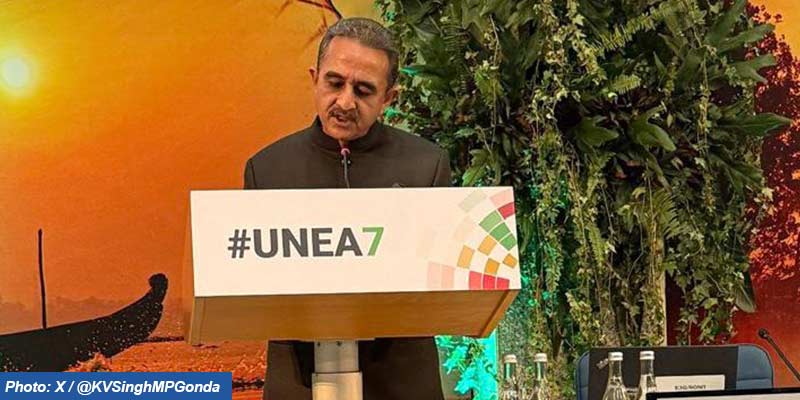
• The seventh session of the UN Environment Assembly (UNEA-7) kicked off on December 8 in the Kenyan capital Nairobi.
• The UN Environment Assembly is the world’s highest decision-making body on the environment – its membership includes all 193 UN Member States.
• It meets biennially to set priorities for global environmental policies; decisions and resolutions then taken by Member States at the Assembly also define the work of the UN Environment Programme (UNEP).
• This year’s theme is “advancing sustainable solutions for a resilient planet”.
• The event brings together ministers of environment, inter-governmental organisations, multilateral environmental agreements, UN system entities, civil society, young people, and the private sector from across the globe to advance solutions for a resilient planet through multilateralism.
• While not legally binding, UNEA-7 resolutions help countries find common ground and have in the past laid the groundwork for precedent-setting international agreements.
History of the UN Environment Assembly
• In 1972, at its 27th session, the UN General Assembly established the United Nations Environment Programme (UNEP) and its Governing Council composed of 58 elected members.
• In 2012, at the United Nations Conference on Sustainable Development, world leaders adopted an outcome document entitled “The Future We Want”.
• Sub-paragraph 88 (a) provided for universal membership in the Governing Council of the UNEP, as well as other measures to strengthen its governance as well as its responsiveness and accountability to Member States.
• Subsequently, the 54-member Governing Council was renamed the United Nations Environment Assembly, with all 193 Member States as its members.
Kirti Vardhan Singh delivers India’s national statement
• Union Minister of State for Environment, Forest and Climate Change Kirti Vardhan Singh delivered India’s national statement at the High-Level Segment of the UNEA-7.
• Singh underscored that India approaches UNEA-7 with the conviction that global environmental solutions must remain people-centred and rooted in equity and Common But Differentiated Responsibilities and Respective Capabilities (CBDR-RC).
• He noted that India’s energy transition including solar, wind, hydropower, biofuels, green hydrogen, offshore renewables, and storage is reshaping our energy landscape.
• Flagship programmes such as PM Surya Ghar and PM-KUSUM are enabling households and farmers to access reliable and affordable clean energy while encouraging active public participation in climate action
• He also underlined India’s lifestyle movement Mission LiFE, which promotes mindful consumption and sustainable lifestyles.
• The country’s ‘Ek Ped Maa Ke Naam’ campaign has become a mass movement, drawing a parallel between caring for one’s mother and nurturing the Earth. More than 2.6 billion saplings have been planted under the initiative to restore degraded landscapes and build ecological resilience.