
- India
- Dec 16
- Sreesha V.M
PM Modi meets King Abdullah II of Jordan
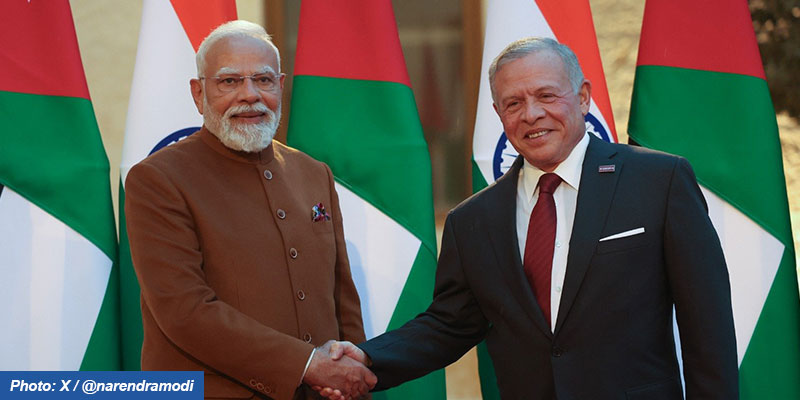
• Prime Minister Narendra Modi met King Abdullah II of Jordan at the Al Husseiniya Palace in Amman on December 15.
• The visit comes at a time when the two countries are celebrating 75 years of the establishment of their diplomatic ties.
• Both the leaders discussed ways to further deepen engagement between the two countries in diverse fields.
• Noting that India was Jordan’s third largest trading partner, PM Modi proposed that the two countries should aim to enhance bilateral trade to $5 billion over the next five years.
• Jordan is an important supplier of fertilizer to India, and companies on both sides are in discussions for further substantive investment in Jordan to meet growing demand for phosphatic fertilizer in India.
• He also called for collaboration between Jordan’s digital payment system and India’s United Payments Interface (UPI).
• The two sides finalised MoUs in the fields of culture, renewable energy, water management, digital public infrastructure and twinning arrangement between Petra and Ellora.
• These agreements would give a major boost to India-Jordan bilateral ties and friendship.
India-Jordan Bilateral Relations
• India’s relationship with Jordan has been characterized by warmth and goodwill based on mutual respect.
• First bilateral agreement for cooperation and friendly relations was signed in 1947 and got formalised in 1950 when the two countries established full-fledged diplomatic ties.
• Over the years, bilateral trade has grown rapidly with India emerging as Jordan’s third largest trading partner.
• In 2023-24 India-Jordan bilateral trade was valued at $2.875 billion with Indian exports to Jordan amounting to $1.465 billion.
• India imports fertilizers, phosphates, phosphoric acid, etc from Jordan and exports electrical machinery, cereals, frozen meat, organic and inorganic chemicals, animal fodders, petroleum products, engineering and automotive parts, etc.
• Among institutional dialogue mechanisms, a Trade and Economic Joint Committee (TEJC) was constituted under the 1976 Trade Agreement to promote and monitor progress in bilateral trade.
(The author is a trainer for Civil Services aspirants.)