
- India
- Dec 16
- Sreesha V.M
Govt introduces ‘Viksit Bharat Shiksha Adhishthan Bill’ in Lok Sabha
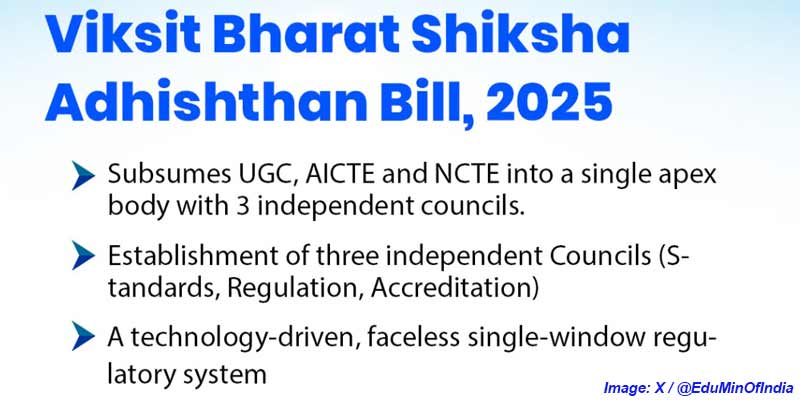
• Union Minister for Education Dharmendra Pradhan introduced the Viksit Bharat Shiksha Adhishthan Bill, 2025 in Lok Sabha on December 15.
• The purpose of the Bill is to empower higher educational institutions to achieve excellence through effective coordination and the determination of standards.
• On December 12, the Union Cabinet approved the ‘Viksit Bharat Shiksha Adhishthan Bill, 2025’ for introduction in Parliament.
• The Bill has been referred to a Joint Parliamentary Committee (JPC) for detailed examination.
Why the govt brings in new Bill?
• Entry 66 of the Union List (List I) in the Seventh Schedule to the Constitution of India provides for the coordination and determination of standards in institutions for higher education or research and scientific and technical institutions.
• The University Grants Commission (UGC) was established under the University Grants Commission Act, 1956 for the coordination and determination of standards in universities.
• Subsequently the size, scale and complexities of the higher education sector in India have increased manifold with over 1,000 universities and more than 60,000 higher educational institutions, with more than four crore students enrolled therein.
• The expansion of higher education system has also seen establishment of several statutory regulatory bodies, requiring multiple approvals by higher educational institutions, inspections, etc, resulting in over-regulation of the sector and duplication of control.
• The National Education Policy (NEP), 2020 envisions the revision and revamping of all aspects of the education structure, including its regulation and governance.
• The NEP, 2020 considers that the regulatory system is in need of a complete overhaul in order to re-energise the higher education sector and enable it to thrive.
• The present challenges faced by higher educational institutions due to multiplicity of regulators having non-harmonised regulatory approval protocols will be done away with.
Key provisions of the Bill:
• The Viksit Bharat Shiksha Adhishthan Bill, 2025 provides for the constitution of a Viksit Bharat Shiksha Adhishthan along with the three Councils to enable and empower universities and other higher educational institutions to achieve excellence in teaching, learning, research and innovation, as an outcome of better coordination and determination of standards in institutions for higher education or research and scientific and technical institutions.
The three councils are:
i) Viksit Bharat Shiksha Viniyaman Parishad (the Regulatory Council).
ii) Viksit Bharat Shiksha Gunvatta Parishad (the Accreditation Council).
iii) Viksit Bharat Shiksha Manak Parishad (the Standards Council).
• The Viksit Bharat Shiksha Adhishthan will be an apex umbrella body to provide direction for comprehensive and holistic growth of higher education and ensure coordination between the Councils.
• The Standards Council shall ensure synchronisation and determination of academic standards in higher educational institutions.
• The Regulatory Council shall ensure coordination and maintenance of standards in higher educational institutions.
• The Accreditation Council shall be an accrediting body to supervise and oversee an independent ecosystem of accreditation.
• Membership of the Viksit Bharat Shiksha Adhishthan and the Councils primarily includes academicians, domain experts and representatives from states, Union Territories, state higher educational institutions and institutions of national importance.
• The Bill further provides for repealing the University Grants Commission Act, 1956, the All India Council for Technical Education Act, 1987 and the National Council for Teacher Education Act, 1993.
• The Bill proposes that the Council of Architecture (CoA), established under the Architects Act, 1972 will function as a Professional Standard Setting Body (PSSB), as envisioned in the NEP, 2020.
• The CoA will have representation in all the three Councils proposed to be established under the proposed legislation.
• As a Member of the Standards Council, the CoA will participate in framing the curricula, laying down academic standards and coordinating between teaching, research and extension of its domain or discipline.
• Thus, CoA would set the standards or expectations in its particular field of learning and practice while having no regulatory role.
(The author is a trainer for Civil Services aspirants.)