
- India
- Dec 17
India, Ethiopia elevate ties to ‘Strategic Partnership’
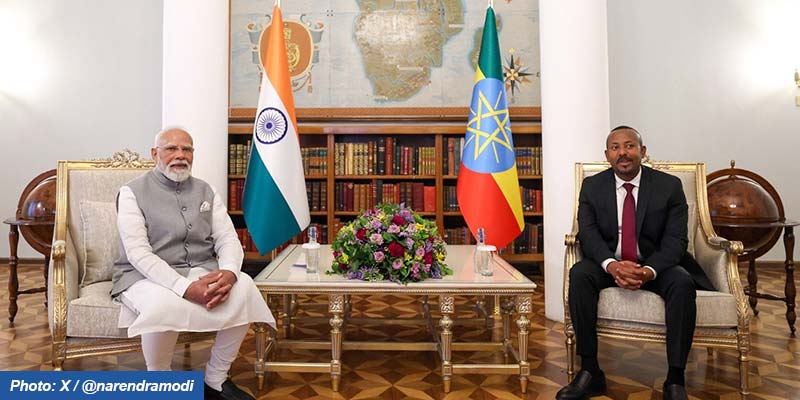
• Prime Minister Narendra Modi met his Ethiopian counterpart Abiy Ahmed Ali at the National Palace in Addis Ababa on December 16.
• The leaders agreed to elevate the India-Ethiopia ties to the level of ‘Strategic Partnership’.
• Both leaders took stock of the progress in the multifaceted partnership between India and Ethiopia, including in areas of trade and investment, innovation and technology, education and capacity building, and defence cooperation.
• They discussed cooperation in the fields of Digital Public Infrastructure, mining, critical minerals and clean energy.
Following the talks, the two leaders witnessed exchange of three MoUs in the fields of:
i) United Nations Peacekeeping Operations Training.
ii) Mutual Administrative Assistance in the Customs Matters.
iii) Establishment of Data Centre at the Ministry of Foreign Affairs of Ethiopia.
• PM Modi addressed the Joint Session of the Ethiopian Parliament.
• This was a special honour accorded to the PM who is on his first bilateral visit to Ethiopia.
India-Ethiopia Bilateral Relations
• Historical linkages between India and Ethiopia goes back 2,000 years of recorded history.
• Trade between the two countries flourished during the Axumite Empire (1st century AD).
• Indian traders traded silk and spices for gold and ivory through the ancient port of Adulis in the 6th Century AD.
• In the 16th century AD, the Portuguese assisted the Christian King in Ethiopia to repel Muslim invaders, and with them came Indians from Goa.
• In 1868, General Robert Napier led a punitive expedition to obtain the release of European diplomats and missionaries who had been imprisoned by Emperor Tewodros II in his bunker fort at Makdala.
• The 30,000 strong force had 13,000 soldiers from India, mostly Sikhs.
• The British Army that ended the Italian occupation of Ethiopia (1936-41) also had a sizeable contingent of Indian soldiers.
• General William Plat, who led one of the three simultaneous attacks, commanded a force consisting of the fourth and fifth Indian Divisions.
• Soon after achieving independence, a goodwill mission led by Sardar Sant Singh was sent to Ethiopia.
• Diplomatic relations at legation level were established in 1948.
• Full diplomatic relations were established in 1950 with Sardar Sant Singh as the first ambassador.
• The early settlers among the Indian community in Ethiopia came from Gujarat in the latter years of the 19th century.
• During imperial times, there were also tens of thousands of Indian teachers in schools all over Ethiopia, even in the most remote parts.
• Today, the Indian community has a large presence in the educational sector of Ethiopia. There are about 150 Indian faculties in various Ethiopian Universities and higher educational institutions.
• The Indian diaspora in Ethiopia is estimated to be about 2,500 people.
• India is the second largest trading partner for Ethiopia.
• India’s total trade with Ethiopia stood at $550.19 million during 2024-2025.
• During this period, India’s exports to Ethiopia were $476.81 million and imports were $73.38 million.
• Exports from India mainly include primary and semi-finished iron and steel products, drugs and pharmaceuticals, machinery and instruments, chemical, paper products, plastic products, manufactures of metal, etc.
• Major imports by India from Ethiopia are pulses, flax yarn, precious and semi-precious stones, vegetables & seeds, leather and spices.
• Indian companies are in the top three foreign investors in Ethiopia with newer Indian multinationals marking their presence in Ethiopia.
• There are more than 675 Indian companies registered with Ethiopian Investment Commission with investment over $6.5 billion.
• Indian investors have created more than 17,000 jobs.
• About 48.3 per cent of Indian investment is in the manufacturing sector.