
- India
- Dec 20
WHO Global Summit charts a bold future for traditional medicine
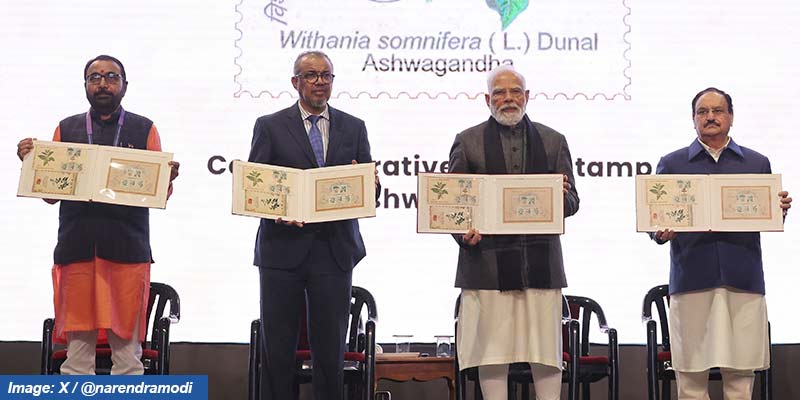
• The second WHO Global Summit on Traditional Medicine, jointly organised by the Ministry of AYUSH, was held in New Delhi from December 17 to 19.
• Prime Minister Narendra Modi met World Health Organisation (WHO) Director General Tedros Ghebreyesus and discussed the immense potential of traditional medicine.
• The inaugural WHO Global Summit on Traditional Medicine in 2023 in Gandhinagar laid the groundwork, offering data, technologies and insights to elevate traditional medicine in the global health agenda.
Traditional medicine
• Traditional medicine has a long history. It is the sum total of the knowledge, skill, and practices based on the theories, beliefs, and experiences indigenous to different cultures, whether explicable or not, used in the maintenance of health as well as in the prevention, diagnosis, improvement or treatment of physical and mental illness.
• Its reach encompasses ancient practices such as acupuncture, ayurvedic medicine and herbal mixtures as well as modern medicines.
• The terms “complementary medicine” or “alternative medicine” refer to a broad set of health care practices that are not part of that country’s own tradition or conventional medicine and are not fully integrated into the dominant health care system. They are used interchangeably with traditional medicine in some countries.
• Traditional and complementary medicine (T&CM) is an important and often underestimated health resource with many applications, especially in the prevention and management of lifestyle-related chronic diseases, and in meeting the health needs of ageing populations.
• Around 80 per cent of the world’s population is estimated to use traditional medicine. As many as 170 of the 194 WHO Member States have reported the use of traditional medicine
• The global popularity of traditional medicine is on the rise, driven by a growing interest in holistic health approaches that emphasize prevention, promotion and rehabilitation.
Key outcomes of the second Summit:
• The theme of the Summit was “Restoring balance: The science and practice of health and well-being”.
• It brought together 800 delegates from more than 100 countries, including ministers from over 20 nations.
• The summit focused on moving beyond recognising the importance of traditional medicine to setting concrete and measurable steps.
• A commemorative postage stamp on Ashwagandha was released, symbolising the growing global recognition of India’s traditional medicinal heritage.
• The ministers, scientists, Indigenous leaders, and practitioners came together to advance the WHO Global Traditional Medicine Strategy 2025–2034.
• WHO unveiled the Traditional Medicine Global Library, a first-of-its-kind digital platform consolidating 1.6 million resources on traditional medicine, from scientific studies to Indigenous knowledge.
• With advanced features like Evidence Gap Maps and an AI-powered tool, TMGL GPT, the library promises to transform access to trusted information and accelerate research worldwide.
• WHO also announced the Strategic and Technical Advisory Group on Traditional, Complementary and Integrative Medicine (STAG-TM), a new advisory body to guide the Global Strategy.
• It will shape research priorities, develop standards, and advise on integration into health systems.
• The summit concluded with the adoption of the Delhi Declaration.
• Countries rallied behind the Delhi Declaration, with commitments from 26 Member States, signaling a new era for traditional medicine.
• This collective pledge focuses on integrating traditional medicine into primary health care, strengthening regulation and safety standards, investing in research, and building interoperable data systems to track outcomes.