
- India
- Dec 22
President grants assent to SHANTI Bill
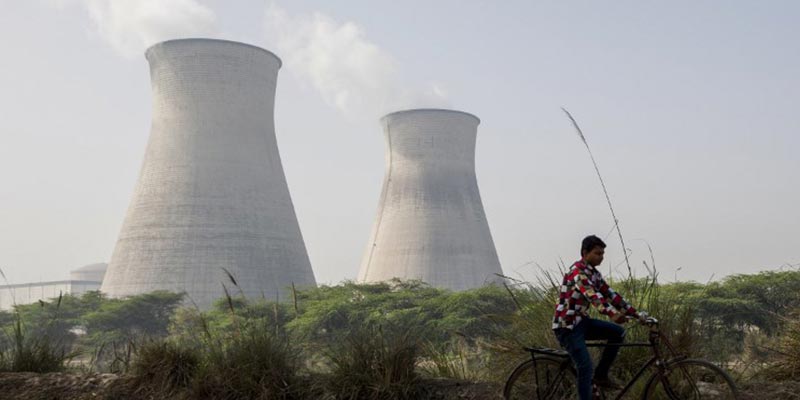
• President Droupadi Murmu has granted assent to the Sustainable Harnessing and Advancement of Nuclear Energy for Transforming India (SHANTI) Bill, passed by Parliament during the Winter Session.
What is nuclear energy?
• Nuclear energy is the use of controlled atomic reactions to produce power.
• At its core, it relies on splitting atoms in a process called fission, which releases large amounts of heat.
• This heat is then used to generate electricity without producing greenhouse gases.
• Globally, nuclear energy is valued as a clean, dependable source that complements renewable options like solar and wind.
• India’s nuclear energy programme has maintained a steady role in the country’s electricity mix and is now poised for significant expansion.
• Nuclear power has consistently accounted for around 3 per cent of total electricity generation, with a share of 3.1 per cent in 2024–25.
• The present nuclear capacity stands at 8.78 GW.
• With 24 nuclear power reactors across seven locations, India operates the sixth largest nuclear reactor fleet in the world.
• With the indigenous 700 MW and 1,000 MW reactors being developed through international cooperation, the capacity is projected to rise to 22.38 GW by 2031-32.
Why the govt brings in new legislation?
• The Atomic Energy Act, 1962 was enacted, after repealing the Atomic Energy Act, 1948, to provide for a legal framework for the development, control and use of atomic energy, for the welfare of the people of India and for other peaceful purposes.
• Thereafter, the Atomic Energy Act, 1962 was amended in the years 1986, 1987 and 2015.
• The progressive amendments over the years gradually broadened the scope of nuclear power production originally confined to the central government, to government companies and joint ventures among them.
• In the year 2010, the Civil Liability for Nuclear Damage Act, 2010 was enacted to provide for civil liability for nuclear damage and prompt compensation to the victims of nuclear incident through a no-fault liability regime.
• India has set an ambitious target to achieve energy independence with a roadmap for decarbonisation of the economy by 2070 and to achieve 100 giga watt of nuclear power capacity by 2047.
• To achieve this goal, it is imperative to enact a new legislation to harness the full potential of India’s nuclear energy and indigenous resources through active involvement of both the public and private sectors.
• It further seeks to leverage the contribution of domestic nuclear energy for augmenting the global nuclear energy ecosystem.
• The Sustainable Harnessing and Advancement of Nuclear Energy for Transforming India Act, 2025 repeals the Atomic Energy Act, 1962 and the Civil Liability for Nuclear Damage Act, 2010.
• The new legislation is aligned to achieve the objectives of increasing the share of nuclear energy in the total energy mix of India, facilitate innovation in nuclear science and technology, expand its applications to non-power applications and continue to honour India’s obligations towards safety, security, safeguards and towards nuclear liability.
• It brings together various elements of nuclear development under a single, comprehensive structure, aiming to create a more streamlined and future-ready system.
• It focuses on a forward-looking approach and its role in shaping India’s long-term energy pathway.
Highlights of the new Act:
i) Private Sector Integration: It permits private companies to participate in India’s nuclear sector, enabling them to undertake plant operations, power generation, equipment manufacturing, and selected activities such as the fabrication of nuclear fuel including conversion, refining and enrichment of uranium-235 up to such threshold value, or production, use, processing or disposal of other prescribed substances. In addition, all activities that involve radiation exposure must obtain prior safety authorisation from the regulatory authority.
ii) Activities Under Exclusive Central Government Purview: Certain sensitive nuclear fuel‑cycle activities are reserved exclusively for the central government or its wholly owned institutions. These include enrichment or isotopic separation of prescribed or radioactive substances (unless otherwise notified), management of spent fuel such as reprocessing, recycling, radionuclide separation, and high-level waste handling, production and upgradation of heavy water, and any other facilities or activities specifically notified by the government.
iii) Regulation of Non-Power Applications: Provides a regulatory framework for the use of nuclear and radiation technologies in health care, agriculture, industry, research, and other peaceful applications.
iv) Civil Liability Framework: Introduces a practical and balanced civil liability regime for addressing nuclear damage.
v) Statutory Body: Grants formal statutory recognition to the Atomic Energy Regulatory Board (AERB) to strengthen regulatory independence and authority.
vi) Enhanced Safety, Security, and Safeguards: Improves systems for security, safeguards, quality assurance, and coordinated emergency preparedness and response.
vii) Central Government Acquisition Rights: Vests exclusive acquisition rights with the central government in specific cases related to nuclear activities.
viii) Dispute Redressal Mechanism: Establishes an Atomic Energy Redressal Advisory Council to facilitate the redressal of disputes.
ix) Appellate Tribunal Provision: The Appellate Tribunal for Electricity, set up under the Electricity Act, 2003, will serve as the appellate authority, empowered to hear appeals under provisions of the Act and any additional matters as notified by the central government.
x) Claims Commissioner Appointment: Empowers the central government to appoint Claims Commissioners for adjudicating compensation claims related to nuclear damage.
xi) Nuclear Damage Claims Commission: Provides for a dedicated Commission to handle cases involving severe nuclear damage and ensure timely adjudication.