
- India
- Dec 30
Navy’s heritage vessel INSV Kaundinya sets off on voyage to Oman
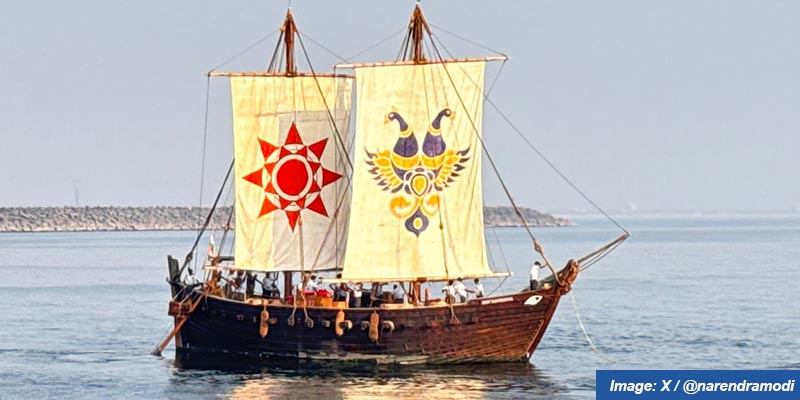
• Indian Naval Sailing Vessel Kaundinya, the Indian Navy’s indigenously built traditional stitched sailing vessel, sailed on her maiden overseas voyage from Porbandar, Gujarat to Muscat, Oman on December 29.
• The voyage retraces ancient maritime routes that once connected the western coast of India with Oman, facilitating trade, cultural exchange and sustained civilisational interactions across the Indian Ocean.
Key facts on INSV Kaundinya:
• In May 2025, the Indian Navy inducted the traditionally-built stitched ship INSV Kaundinya.
• It is a recreation of a fifth-century vessel and is named after Kaundinya, inspired by a painting from the Ajanta Caves.
• Named after Kaundinya, the legendary Indian mariner who sailed across the Indian Ocean to Southeast Asia, the ship serves as a tangible symbol of India’s long-standing traditions of maritime exploration, trade, and cultural exchange.
• The project was initiated through a tripartite agreement signed in July 2023 between the Ministry of Culture, the Indian Navy, and Hodi Innovations, with funding from the Ministry of Culture.
• The keel laying of the ship took place in September 2023.
• The ship’s construction was carried out entirely using traditional methods and with raw materials by artisans from Kerala, led by master shipwright Babu Sankaran, who executed thousands of hand-stitched joints.
• Over several months, the team painstakingly stitched wooden planks on the ship’s hull using coir rope, coconut fibre and natural resin.
• The ship was launched in February 2025 at Hodi Shipyard, Goa.
• The Navy has overseen the entire spectrum of implementation of this project, including concept development, design, technical validation and construction.
• The Indian Navy played a central role in the project, overseeing the design, technical validation, and construction process. With no surviving blueprints of such vessels, the design had to be inferred from iconographic sources.
• The Navy collaborated with the shipbuilder to recreate the hull form and traditional rigging, and ensured that the design was validated through hydrodynamic model testing at the Department of Ocean Engineering, IIT Madras, and internal technical assessment.
• The ship serves as a tangible symbol of India’s long-standing traditions of maritime exploration, trade, and cultural exchange, and its induction and naming marks a culmination of a project that celebrates India’s rich shipbuilding heritage.
• Unlike any modern vessel, the stitched ship is equipped with square sails and steering oars, which are entirely alien to modern-day ships. The hull geometry, rigging, and sails had to be reimagined and tested from first principles.