
- India
- Jan 06
- Sreesha V.M
India’s first commercial rainbow trout aquaculture farm inaugurated in Telangana
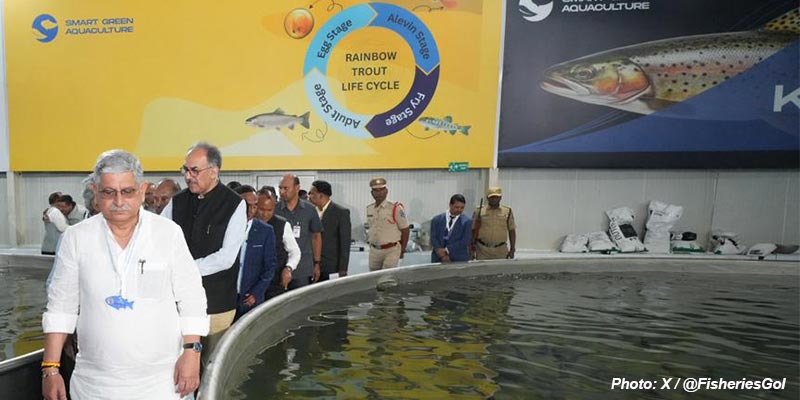
• Union Minister for Fisheries, Animal Husbandry and Dairying Rajiv Ranjan Singh inaugurated India’s first commercial-scale tropical Recirculating Aquaculture System (RAS)-based rainbow trout farm and research institute in Telangana on January 5.
Important points on rainbow trout:
• Onchorhynchus mykiss, popularly known as rainbow trout, is one of the promising cultivable fish species in coldwater.
• Being a low volume high value commodity, the trout has good potential for domestic consumption as well as foreign export.
• This species is native to the Pacific drainages of North America ranging from Alaska to Mexico.
• However, it is the world’s most widely introduced fish species which is cultured over 100 countries including India.
• In India, this species was transplanted from Europe by British settlers around the beginning of the last century primarily to meet their needs for sport fishing or recreational angling.
• But, since the early 90s, the country has taken-up farming of rainbow trout in hills and aquaculture of rainbow trout is gaining significance in the context of income generation, employment opportunities and food security to the people of the hills.
• There are several species of trout, but rainbow trout is a species of choice for coldwater aquaculture.
• Certain features such as the base of anal fin shorter than its height, moderate sized scales and dark-colored spots on the body distinguish this species from the other salmonids.
• Elongated fusiform body with 60-66 vertebrae, 3-4 dorsal spines, 10-12 dorsal soft rays, 3-4 anal spines, 8-12 anal soft rays, 19 caudal rays, presence of adipose fin, absence of nuptial tubercles and body coloration of blue to olive green above a pink band along the lateral line are identifying characteristics of this species.
Highlights of the facility in Telangana:
• It demonstrates that high-value cold-water species can be farmed year-round in tropical climates using precision engineering and advanced water recirculation technologies.
• The project overturns the long-standing assumption that premium aquaculture species are geographically constrained to specific climatic zones, establishing technology rather than climate as the primary determinant of aquaculture viability.
• The facility also functions as a live training and demonstration platform, providing youth with hands-on experience in advanced aquaculture systems, automation, and biosecurity.
• Trout farming, largely concentrated in Himalayan and hill states such as Uttarakhand, Himachal Pradesh, Jammu & Kashmir, Arunachal Pradesh and Sikkim, leverages cold, well-oxygenated water from snow-fed streams and rivers.
• The Department of Fisheries has developed rainbow trout hatcheries that have substantially increased fish production and created local employment.
• With new hatcheries and advanced aquaculture techniques, annual production of 14 lakh trout seeds has been achieved.
• Uttarakhand has signed an MoU with the Indo-Tibetan Border Police (ITBP) under the vibrant village scheme to provide trout fish.
• The Department of Fisheries has also notified the development of cold-water fisheries clusters in Jammu & Kashmir, Ladakh, Uttarakhand and Himachal Pradesh.
(The author is a trainer for Civil Services aspirants.)