
- India
- Jan 08
- Sreesha V.M
India becomes first country to commercially produce bio-bitumen
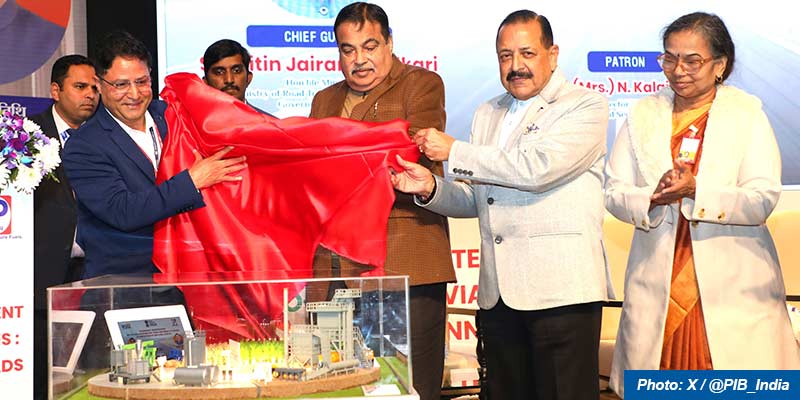
• Union Minister for Road transport and Highways Nitin Gadkari said that India has become the first country in the world to commercially produce bio-bitumen.
• He was speaking at CSIR’s Technology Transfer Ceremony titled ‘From Farm Residue to Road: Bio-Bitumen via Pyrolysis’ on January 7.
• Gadkari noted that bio-bitumen is a transformative step towards the vision of Viksit Bharat@2047.
• By utilising agro-waste, it reduces pollution caused by crop burning and strengthens the circular economy.
• With 15 per cent blending, India can save nearly Rs 4,500 crore in foreign exchange and substantially reduce its dependence on imported crude oil.
• Bio-bitumen reflects the government’s commitment to sustainable development, self-reliance, and environmentally responsible growth, paving the way for a cleaner and greener future.
• This innovation will empower farmers, generate rural livelihoods, and boost the rural economy.
What is bitumen?
• Bitumen is a black or dark-coloured material that can be solid, semi-solid, or viscous.
• It is amorphous and cementitious.
Forms of bitumen:
• Found in rock asphalt, natural bitumen, tar.
• Derived from oil as petroleum bitumen.
Formation of bitumen:
• Originates more than 360 million years ago during the Carboniferous period.
• Giant swamp forests with many microscopic organisms contributed to its formation.
• Decay of these organisms led to coal deposits.
• Sediment layers accumulated and transformed under heat and pressure, creating bituminous coalfields.
Significance of bio-bitumen
• Nearly 49 per cent of the national bitumen requirement is met through imports, resulting in an annual foreign exchange outgo of approximately Rs 25,000 crore.
• This dependence exposes the sector to global crude oil price volatility and supply-chain risks.
• At the same time, India generates more than 600 million tonnes of agricultural residue annually.
• A significant fraction of this biomass, particularly rice straw (parali), is burnt in open fields due to the absence of economically viable utilisation pathways, leading to severe air pollution, greenhouse gas emissions, soil nutrient loss and public health impacts.
• Addressing these challenges independently has yielded limited success.
• A convergent solution that simultaneously reduces bitumen import dependence and mitigates stubble burning is therefore essential for sustainable, resilient and environmentally responsible road infrastructure development.
• CSIR-CRRI, in collaboration with CSIR-Indian Institute of Petroleum (IIP), has developed an innovative bio-bitumen technology using pyrolysis of rice straw.
• The resulting bio-oil is upgraded through chemical unit operations to produce a bio-binder suitable for flexible pavement applications, either as a partial replacement or as a modifier to conventional viscosity grade-grade bitumen.
Technology Process
• Pyrolysis of Rice Straw: Controlled thermal decomposition of rice straw produces bio-oil, bio-char and gaseous products.
• Bio-Binder Production: Rice straw is densified into pellets and processed through pyrolysis to obtain bio-oil, which is further upgraded into a bio-binder suitable for flexible pavement applications.
• Bio-binder is used in hot mix asphalt with conventional equipment and practices.
(The author is a trainer for Civil Services aspirants.)