
- India
- Jan 08
Goyal reviews India-EFTA TEPA implementation
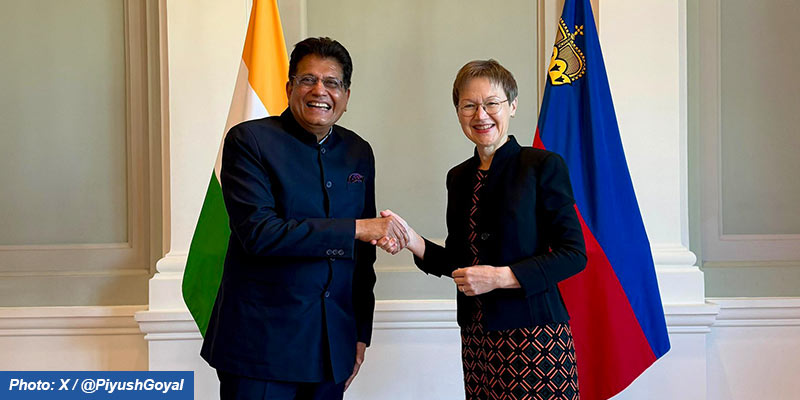
• Union Minister of Commerce and Industry Piyush Goyal undertook an official visit to Liechtenstein on January 7.
• Goyal invited Liechtenstein companies to use India-EFTA Trade and Economic Partnership Agreement (TEPA) as a platform to grow their India presence, build manufacturing and innovation partnerships, and participate in India’s expanding opportunities across sectors.
European Free Trade Association (EFTA)
• The European Free Trade Association (EFTA) is an inter-governmental organisation of Iceland, Liechtenstein, Norway and Switzerland.
• It was set up in 1960 by its then seven Member States for the promotion of free trade and economic integration between its members.
• There were seven founding countries: Austria, Denmark, Norway, Portugal, Sweden, Switzerland and the United Kingdom (UK). They were joined by Iceland in 1970, by Finland in 1986 and by Liechtenstein in 1991.
• Meanwhile, in 1973, Denmark and the UK joined the EU. Portugal joined the EU in 1986. Austria, Finland and Sweden joined the EU in 1995, consequently leaving EFTA.
• EFTA does not envisage political integration. It does not issue legislation, nor does it establish a customs union.
• EFTA’s first objective was to liberalise trade between its Member States.
• EFTA countries enjoy access to one of the world’s largest networks of preferential trade relations, covering 80 per cent of EFTA’s merchandise trade.
• Currently, the EFTA States have signed 33 free trade agreements (FTAs) with 44 countries and territories outside the European Union. The agreements have entered into force for 40 of these countries.
• EFTA is the European Union’s third largest trading partner in merchandise, and the second largest in services.
• The EFTA Council is the highest governing body of EFTA. The Council usually meets eight times a year at the ambassadorial level (heads of permanent delegations to EFTA) and once a year at ministerial level.
• The EFTA Secretariat is situated in Geneva.
EFTA States
• Switzerland is a world leader in pharmaceuticals, biotechnology, machinery, banking and insurance.
• Liechtenstein, like Switzerland, is highly industrialised and specialised in capital-intensive and research & development driven technology products.
• The Icelandic economy benefits from renewable natural resources, not least rich fishing grounds, and has increasingly diversified into other industries and services.
• Abundant natural resources also contribute significantly to Norway’s economic strength, including oil and gas exploration and production, and fisheries, as well as important service sectors such as maritime transport and energy-related services.
• Among EFTA countries, Switzerland is the largest trading partner of India followed by Norway.
India-EFTA TEPA
• The India-EFTA Trade and Economic Partnership Agreement (TEPA) was signed on March 10, 2024 in New Delhi.
• It entered into force on October 1, 2025, representing a significant milestone in the trade and economic relations between the parties.
• The EFTA States collectively rank among the global leaders in both merchandise and services trade.
• The four EFTA states have pledged to increase foreign direct investment (FDI) in India by $50 billion within the first 10 years, followed by an additional $50 billion in the next five years.
• EFTA has offered tariff concessions on 92.2 per cent of tariff lines, covering 99.6 per cent of India’s exports, including all non-agricultural goods and processed agricultural products.
• India, in turn, has extended access on 82.7 per cent of tariff lines, accounting for 95.3 per cent of EFTA exports, but with strong safeguards.
• Over 80 per cent of imports from EFTA comprise gold, where no change in effective duty has been made.
• Sensitive sectors such as dairy, soya, coal, pharmaceuticals, medical devices, and select food products have been kept in the exclusion list.
• For products under flagship programmes like Make in India and the Production Linked Incentive (PLI) Scheme, tariff reductions are phased over 5-10 years, giving domestic industries time to strengthen before full competition opens.
• TEPA is expected to boost India’s services exports in core areas such as IT and business services, cultural and recreational services, education, and audio-visual services.
• Together India and the EFTA States represent a combined GDP of about $5.4 trillion, providing the scale for deeper integration.
• The parties will pursue balanced and sustainable outcomes by expanding total trade and strengthening value‑chain integration across goods, services and investment, supported by standards cooperation and regulatory dialogue.
• It provides enhanced market access and streamlines customs procedures, making it easier for Indian and EFTA businesses to expand their operations into growing markets.
• The agreement also aims to facilitate and promote investment opportunities between the parties, creating an environment for Indian and EFTA businesses to innovate, expand and prosper.