
- India
- Jan 09
WCD ministry launches ‘Pankhudi’ portal
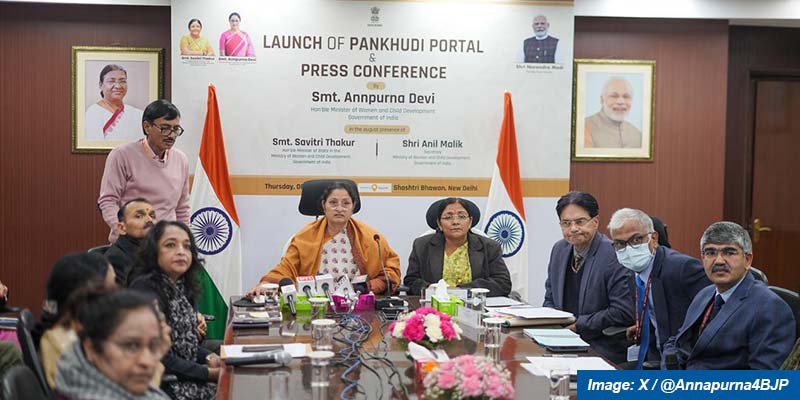
The Union Women and Child Development Minister Annpurna Devi launched ‘Pankhudi’ portal on January 8.
What is the purpose of the portal?
• The portal is an integrated Corporate Social Responsibility (CSR) and partnership facilitation digital portal aimed at strengthening coordination, transparency, and structured stakeholder participation in initiatives for women and child development.
• It is developed as a single-window digital platform that brings together individuals, Non-Resident Indians (NRIs), Non-Governmental Organisations (NGOs), CSR contributors, corporate entities, and government agencies working in the domain of women and child development.
• The web portal will streamline the voluntary and institutional contributions across key thematic areas, including nutrition, health, early childhood care and education (ECCE), child welfare, protection and rehabilitation, and women’s safety and empowerment.
• The government agencies working in the domain of women and child development can also make contributions through this portal.
• The portal will strengthen the implementation of the ministry’s flagship missions — Mission Saksham Anganwadi & Poshan 2.0, Mission Vatsalya, and Mission Shakti — through a structured and transparent digital mechanism.
• The contributors can register on the portal, identify initiatives, submit proposals, and track the status of their contributions through clearly defined approval workflows.
• Designed to ensure transparency, accountability, and traceability, the portal facilitates collaboration among central and state government departments, implementing agencies, civil society organisations, and stakeholders from the public and private sectors.
• To further strengthen financial transparency and accountability, all contributions through the portal are accepted only through non-cash modes.
• The launch of Pankhudi portal marks a significant step towards leveraging digital solutions for outcome-oriented development of women and children across India.
• The initiative will improve the infrastructure and services being provided through more than 14 lakh Anganwadi Centres, 5,000 Child Care Institutions, around 800 One Stop Centres (OSCs), and various other institutions, leading to the ease of living of common citizens.