
- India
- Jan 16
India Meteorological Department celebrates 151st Foundation Day
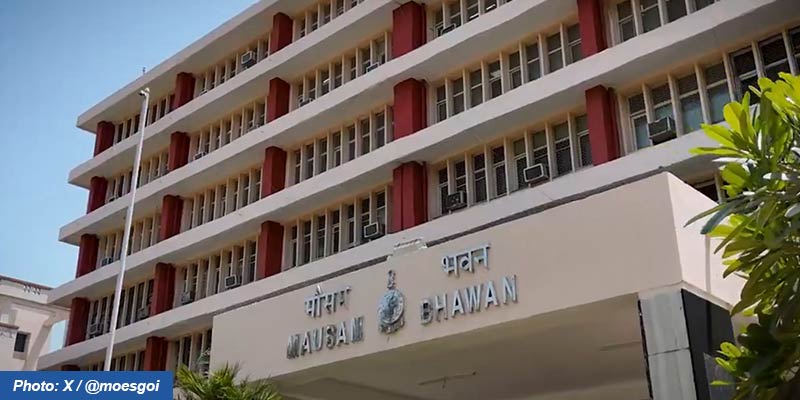
•The India Meteorological Department (IMD) celebrated the 151st Foundation Day on January 15.
Establishment of IMD
• India had some of the oldest meteorological observatories of the world and the first astronomical and meteorological unit started at Madras in 1793.
• A disastrous tropical cyclone struck Calcutta in 1864 and this was followed by famine in 1866 and 1871.
• On January 15, 1875, the India Meteorological Department (IMD) was established with its headquarters in Calcutta, bringing all meteorological work in the country under a central authority.
• The headquarters was shifted to Shimla in 1905, to Pune in 1928 and then to Delhi in 1944.
• It is the national meteorological service of the country and the principal government agency for all weather and climate services.
• IMD has been at the forefront of providing critical weather and climate services, playing a vital role in disaster management, agriculture, aviation, and public safety.
• From a modest beginning in 1875, IMD has progressively expanded its infrastructure for meteorological observations, communications, forecasting and weather services.
• In the telegraph age, it made extensive use of weather telegrams for collecting observational data and sending warnings.
• Later, IMD became the first organisation in India to have a message switching computer for supporting its global data exchange.
• One of the first few electronic computers introduced in the country was provided to IMD for scientific applications in meteorology.
• India was the first developing country in the world to have its own geostationary satellite — INSAT — for continuous weather monitoring of this part of the globe and particularly for cyclone warning.
• Since its establishment, the IMD has served the cause of safety and well-being of people against weather related hazards and helped in the economic development of the country.
• It is one of the few departments of the government whose services touch almost every aspect of life and across all sectors of economy.
• It functions under the Ministry of Earth Sciences (MoES) with its headquarters at Mausam Bhawan in New Delhi.
• IMD houses advanced meteorological instruments, state-of-the-art computing platforms, weather and climate prediction models, information processing and forecasting system and warning dissemination system.
• The Director General of meteorology is the head of the IMD.
• IMD works in a coordinated manner with headquarters at Delhi and six Regional Meteorological Centers (RMCs) catering to six different regions of the country. These RMCs are further assisted by 26 Meteorological Centers (MCs) at state level that are specialised for observing and disseminating information, advisories and warnings about regional weather.
• The different dedicated divisions in IMD headquarters like National Weather Forecasting Center (NWFC), Numerical Weather Prediction (NWP), Satellite Meteorology Division, Upper Air Instrument Division, Hydrology division and Information System & Services Division (ISSD) and Climate Research & Services Division of IMD Pune support the overall forecasting, monitoring and dissemination services of IMD.
• IMD is not only catering to the Indian region but also provides cyclone forecast and warning services to 13 north Indian Ocean countries along with forecast and warning services to SAARC nations.
Adoption of new technologies
• IMD has been at the forefront of meteorology, seismology, and allied disciplines, playing an integral role in safeguarding lives, supporting economic development, and advancing scientific research for societal benefit.
• IMD has adopted new techniques and technologies over time over time to detect, monitor, and provide timely early warnings for disruptive weather events.
• The IMD has expanded its infrastructure for observations, data exchange, monitoring & analysis, forecasting, and warning services in the country.
• IMD consistently issues timely alerts and forecasts to the public and concerned stakeholders. Various steps have been taken to ensure effective dissemination of warnings to vulnerable populations.
• The major new initiative undertaken by the government is the implementation of the Mission Mausam.
• A couple of Doppler Weather Radars (DWRs) have already been installed under the mission. Currently, 47 radars are in operation across India, with 87 per cent of the country’s total area under radar coverage.
• In the coming years, DWRs will be installed as per the requirement to cover the remaining gap areas in the country, provide redundancy, and replacement of old radars in the DWR network under Mission Mausam of MoES.
• Under the Mission Mausam, the Bharat Forecast System (BharatFS), an advanced weather forecasting model, has been developed and is operational at a high spatial resolution of 6 km.
• It also has the capability to provide predictions of rainfall events up to 10 days, covering the short and medium-range forecasts.
• Due to its higher resolution and improved dynamics, it generates weather forecasts at the panchayat or cluster of panchayats level.
• Improving the accuracy of weather forecasts requires advanced observational networks, skilled human resources for research and development of numerical models, and robust infrastructure such as high-performance computing systems to run these models at the required resolution.
• IMD currently is equipped with a Decision Support System (DSS) based real-time multi-hazard impact based early warning system (EWS), which integrates all types of real-time and historical data, numerical weather prediction products, etc, to effectively monitor, detect and provide timely forecasts and impact-based warnings with suggested actions up to districts and city/station levels against all types of extreme weather events such as heavy rainfall events, droughts, etc.
• IMD has Met Centres (MCs) in each state and also special centers like Cyclone Warning Centres available for each impacted state, which provide services during cyclones and heavy rainfall seasons round the clock, respectively.
• As a result of these new initiatives, the overall skill of forecasting these severe weather events has been improved by 30-40 per cent over the last 10 years.
• The IMD has developed various mobile apps for the dissemination of weather-related warnings. They are:
i) Mausam app for weather forecasting and warnings.
ii) Meghdoot app for agro met services.
iii) Damini app (developed by IITM) for lightning warning.
iv) Umang app (developed by MeitY) for Weather forecasting and warnings
• IMD has been strengthening and modernising its monitoring and early warning systems in order to minimise the impact of increased extreme weather events linked to climate change.