
- India
- Jan 17
Sukhatme National Award in Statistics
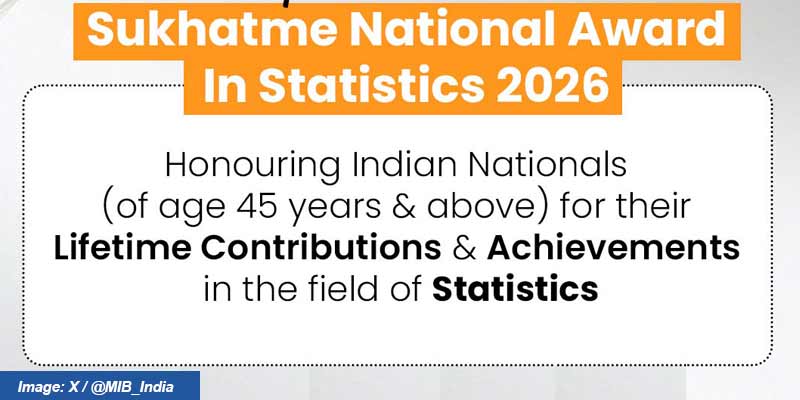
• The Ministry of Statistics & Programme Implementation (MoSPI) nominations have been invited online for Sukhatme National Award in Statistics - 2026.
• Sukhatme National Award has been instituted to recognise the exceptional/ outstanding contribution made by the individuals in terms of high-quality research work, to improve the system of official statistics.
• It is instituted in the memory of P.V. Sukhatme, a renowned statistician for his outstanding contribution and distinguished service to the cause of statistics and its application to agriculture and allied fields.
• This award is given in alternate years since the year 2000 to eminent Indian statisticians of the age 45 years and above for their lifetime contributions and achievements in the field of statistics.
• The Award will be presented during the Statistics Day function on June 29, 2026.
• The Award carries a citation, shawl and memento.
Who was P.V. Sukhatme?
• Pandurang Vasudeo Sukhatme was born on July 27, 1911 in Budh village near Pune.
• After completing his school education in Pune he graduated in 1932 from Fergusson College with mathematics as the principal subject and Physics as a subsidiary subject.
• During 1933-36, he studied at the University College, London and was awarded a PhD in 1936 and a DSc degree in 1939 for his work on bipartition functions.
• This work was published in the ‘Philosophical Transactions of the Royal Society of London, Series A’, June 1938.
• Whilst in London, Sukhatme came under the influence of such eminent authorities in Statistics as R.A. Fisher, Jerzy Neyman and E.S. Pearson.
• He did research in Statistical Theory of Sampling, his two most significant contributions being, one to bipartitional functions under the guidance of R. A. Fisher and the other to sampling theory entitled ‘Contributions to the Theory of the Representative Method’ under the guidance of J. Neyman and E.S. Pearson.
• The latter paper laid solid foundations for his subsequent pioneering research in the sampling theory of surveys and improvement of agricultural statistics which ushered in what may be appropriately termed as the “Sukhatme era” in the development of agricultural statistics in India and the world.
• During 1939-40, he was a professor at the All India Institute of Hygiene and Public Health, Calcutta.
• In 1940, he joined ICAR as a statistician, and was later on appointed as statistical advisor to the Council to head its Statistical Unit.
• Sukhatme, as a founder of the Indian Society of Agricultural Statistics, devoted a good deal of his time and energy to the popularisation of statistical methods among the practitioners of agricultural, veterinary and related sciences.
• He served as the First Honorary Secretary of the Indian Society of Agricultural Statistics for a number of years.
• From its inception to 1963 he worked closely with Dr. Rajendra Prasad (Founder President of the Society), the then Minister for Food and Agriculture and later President of India.
• During 1952-70, he headed the Statistics Division of the Food & Agriculture Organisation(FAO) of the United Nations in Rome.
• He authored several books on the various scientific topics of interest and published more than 200 research papers in reputed national and international journals.
• He was well known in the field of nutrition for the Sukhatme-Margen hypothesis which in plain language implies the following: At low levels of calorie intake, energy is used with greater metabolic efficiency and efficiency decreases as the intake increases over the homeostatic range.
• For his outstanding contribution to Science and Human Welfare, he was conferred the Padma Bhushan in 1973.
• He was awarded the Guy Medal by the Royal Statistical Society for his paper on nutrition which he presented to the Society in 1963.
• He was elected member of the International Statistical Institute, Netherlands and its vice president in 1969-70.
• Sukhatme passed away on January 28, 1997.