
- India
- Jan 21
Govt reduces jute stock limits for traders
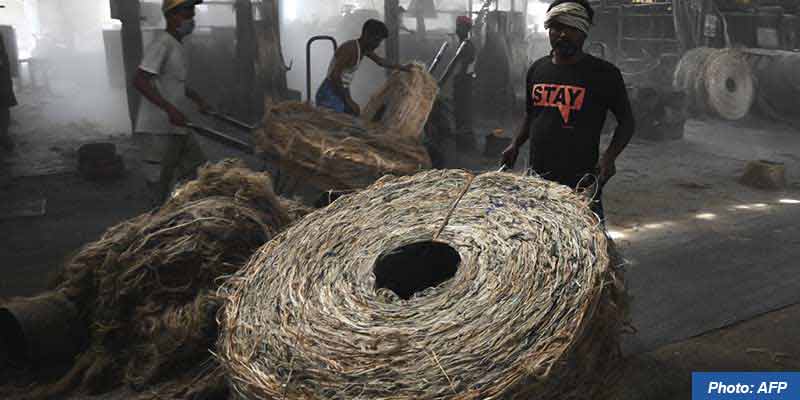
• The Jute Commissioner has reduced the permissible stockholding limits for raw jute by traders and mills with immediate effect, amid a surge in prices.
• The move partially modified an earlier order issued in December 2025 and was aimed at curbing hoarding and stabilising the raw jute market.
• The revision has been necessitated by the sharp rise in jute prices in the past few months.
• According to a notification under the revised norms, registered balers can now hold a maximum of 1,200 quintals of raw jute, while the limits for other registered stockists have been capped at 150 quintals.
• Unregistered traders have been barred from holding more than 5 quintals.
• State police and enforcement agencies have been authorised to enter premises, verify stock declarations and seize raw jute held in violation of the order.
Jute industry in India
• India is the largest producer of jute, also called the “golden fibre”, in the world.
• In trade and industry, jute and mesta crop together known as raw jute as their uses are almost same.
• Raw jute was originally considered as a source of raw material for packaging industries only. But it has now emerged as a versatile raw material for diverse applications, such as, textile industries, paper industries, building and automotive industries, use as soil saver, use as decorative and furnishing materials, etc.
• Raw jute being bio-degradable and annually renewable source, it is considered as an environment-friendly crop and it helps in the maintenance of the environment and ecological balance.
• The production of jute and mesta in India is estimated to be 80.65 lakh bales and 3.90 lakh bales respectively.
• Jute cultivation is mainly concentrated in eastern and northeastern India while that of mesta cultivation is spread almost throughout the country.
• It is estimated that the jute industry provides direct employment to 4 lakh workers in organised mills and in diversified units including tertiary sector and allied activities and supports the livelihood of 40 lakh farm families. In addition, there are a large number of persons engaged in the trade of jute.
• As per the Office of Jute Commissioner, there are 116 composite jute mills. West Bengal has the highest number of jute mills (86).
• The Jute Corporation of India (JCI) was established in 1971. It is the official agency of the ministry of textiles responsible for implementing the MSP policy for jute producers and serves as a stabilising agency in the raw jute market. JCI also undertakes commercial operations, procuring jute at prices above the MSP on commercial consideration to generate profits.
• The schemes for promotion of the jute sector are primarily implemented by the National Jute Board, which is a statutory body created for the development and promotion of the sector.
• Jute-ICARE has been launched for increasing the income of jute farmers by at least 50 per cent by using certified seeds, modern agronomic practices in jute cultivation and also by using microbial consortium to upgrade the quality of jute.
• The promotion of Jute Geo-Textiles and Agro-Textiles have been taken up with the state governments, particularly those in the northeast region and also with departments such as ministry of road transport and ministry of water resources.
• A software platform ‘JUTE-SMART’ (Jute Sacking Supply Management and Requisition Tool) has been set up for procurement of jute sacking from November 1, 2016.